
Breakdown: James Currier, NFX Investor, on How to Move Faster as a Startup
James Currier on why startup speed is really about shortening the path to useful feedback: deadlines before scope, successive versions, and clearer customer language.

How to move faster as a startup comes down to shortening the distance between an idea and useful feedback, not simply working longer. In a My First Million conversation with host Shaan Puri, NFX investor and former Tickle CEO James Currier argues that deadlines, founder psychology, and clear language determine that distance. Currier reports that his post-Tickle incubator launched 24 products in three years, with three becoming businesses that gained traction.
The useful argument is not that every founder should imitate Elon Musk. It is that founders often accept timelines, approval processes, and product complexity without testing whether those constraints are necessary.
TL;DR
- Fix the deadline before the scope. Decide what can reach users within 30 days rather than estimating the time needed for an ideal product.
- Optimize for successive versions. An imperfect, measurable release creates information that planning cannot.
- Test the promise early. Customer-facing language should help define the product, not arrive after development.
- Remove emotional and organizational delays. Fear of embarrassment, unnecessary meetings, and defensive reactions all slow decisions.
- Borrow established concepts. Originality is not the same thing as customer value.
How to Move Faster as a Startup
What does Currier mean by a startup’s speed advantage?
Currier means completing more meaningful attempts within the same period. His argument starts with uncertainty: most early approaches will fail, so a startup needs to discover the failures cheaply enough to reach something customers want.
He says NFX developed a list of 48 founder attributes over roughly 25 years of startup experience. In his assessment, those attributes ultimately pointed toward one question: how quickly does a founder make things happen?
Puri illustrates the advantage with a chess thought experiment. Extra resources may not help an inexperienced player defeat a grandmaster, but taking multiple turns for each opponent’s turn changes the contest. For startups facing better-funded incumbents, speed can create that asymmetry.
Roger’s take: I would measure the interval between a decision and evidence. A calendar full of activity can still produce a very slow company. Meetings are excellent at reproducing themselves.
Why do founders underestimate how quickly work can happen?
Currier believes people inherit their expectations from schools and large companies. Those environments normalize semesters, long project schedules, and coordination processes that may not fit a small startup.
He calls this expectation a founder’s “speed bar.” Resetting it begins with encountering someone whose normal pace makes the old schedule look optional.
His example is entrepreneur Mike Cassidy, whom Currier and Puri describe as having achieved a reported $500 million company sale in 500 days. Currier recalls Cassidy compressing activities dramatically:
- Prototypes built in three weeks rather than the 12 months others expected.
- Fundraising completed in three days rather than three months.
- Team hiring concentrated into 72 hours rather than six months.
- Investor meetings scheduled within a 36-hour window.
Those are Currier’s recollections, not operating benchmarks every business can reproduce. The practical question is which parts of a schedule reflect actual work and which reflect waiting.
Should a founder set a launch deadline or define the finished product first?
Currier recommends setting the time constraint first, then designing the scope around it. A 30-day window forces different decisions from an open-ended ambition to build the complete product.
He describes working with the team behind Meerkat after earlier development cycles had taken 18 months and then eight months. During a 90-minute whiteboard session, they outlined five possible products, assigned names and colors, and planned successive 30-day launches.
Meerkat actually took 60 days, according to Currier. That missed the target but substantially shortened the previous cycle. When Meerkat’s momentum collapsed amid problems involving Twitter, the team already had another direction planned: Houseparty, which was later sold.
The backup ideas mattered psychologically. Each release became an experiment rather than a referendum on the founders’ entire identity.
Roger’s take: I would turn that into a short planning document:
- Deadline: When must something usable exist?
- Promise: What useful outcome must the release deliver?
- Minimum scope: What is necessary to test that promise?
- Deferred work: What can wait for another version?
- Next decision: What will the team need to learn from the release?
Does moving faster mean accepting lower quality?
Currier’s argument is that a first release may be rougher, while the product improves sooner through repeated testing. The comparison is not a rushed first version against a polished first version. It is several informed versions against one release built mostly from assumptions.
He points to SpaceX and Stoke Space as examples of organizations applying urgency beyond consumer software. His broader point is that technical difficulty does not automatically justify every inherited process.
There is also a collaboration benefit. Currier argues that more people can improve a concrete object than invent one from a verbal description. Puri gives writing as an example: an AI-generated rough draft can make the necessary edits obvious.
Roger’s take: I would borrow the iteration principle, not treat the rocket comparisons as a universal permission slip. A small test with useful feedback is the goal. Sloppiness without learning is just rework with a motivational poster.
Choosing What to Build Before Building More
How can better positioning accelerate product development?
Currier recommends finding language that expresses a recognizable customer desire, then building a product that fulfills it. He treats positioning as a product input rather than a launch-day writing assignment.
For an AI product, he notes that labels such as assistant, calendar, family planner, and chief of staff suggest different jobs. Choosing one changes both customer expectations and the team’s development priorities.
His clearest operating example involves a photo website. Currier says he changed the homepage’s emphasis from storage to sharing. The three-person team objected that the product lacked sharing functionality, then added the relevant features within 48 hours. He reports that growth accelerated afterward, without providing a measured growth figure.
Roger’s take: I would use the promise to expose missing functionality before launch, not advertise an unavailable capability as though it already exists. The useful exercise is alignment:
- What does the customer expect after reading the headline?
- Which feature makes that expectation true?
- Which planned features do nothing to support it?
What does NFX’s reported $150 million fundraising story teach about language?
Currier’s fundraising story shows how a familiar category can matter more than an elaborate explanation of differentiation. He reports that NFX raised $150 million within six weeks after changing its pitch.
NFX initially operated as an accelerator. After two and a half years, Currier says the partners sought $150 million to support their intended investment pace. Six prospective limited partners declined the accelerator pitch.
Currier pressed one investor for a candid explanation. The objection concerned accelerators as an asset class, not merely NFX’s presentation. He then attended an LP event in Boston, studied other presentations, and rewrote the deck using categories investors already understood.
The revised emphasis was a recognizable venture investment proposition, paired with access to attractive deals and the judgment to select them.
The lesson is not that wording guarantees funding. It is that a buyer or investor must first understand what kind of decision is being requested. Differentiation cannot help much when the proposal has already landed in a rejected category.
Does a startup need a completely original idea?
Currier argues that founders can begin with an established customer behavior and compete through execution, distribution, or a different implementation. Novelty is not a prerequisite for building something valuable.
His strongest firsthand example involves Michael Birch and Bebo. Currier says their teams initially operated from the same codebase by agreement, then developed different products as their circumstances and decisions diverged.
Currier reports that Bebo reached 53 million people and his team’s related product reached 47 million over the following six months. Those are reported growth figures, not independently demonstrated results here.
His sweeping claims about Google and Facebook are more provocative than a builder needs. The narrower distinction is useful:
- Market risk: Whether people want the category or behavior.
- Technology and execution risk: Whether the team can deliver a compelling implementation.
Roger’s take: I would borrow evidence of demand, not assume that a familiar category removes every commercial risk. Currier’s own emphasis on distribution and network effects makes clear that building the product is only part of the contest.
Removing the Delays Inside the Founder and Team
What three changes does Currier recommend for increasing speed?
Currier identifies three starting points: recognize that faster execution is possible, manage resistance from the surrounding network, and reduce the influence of fear and ego.
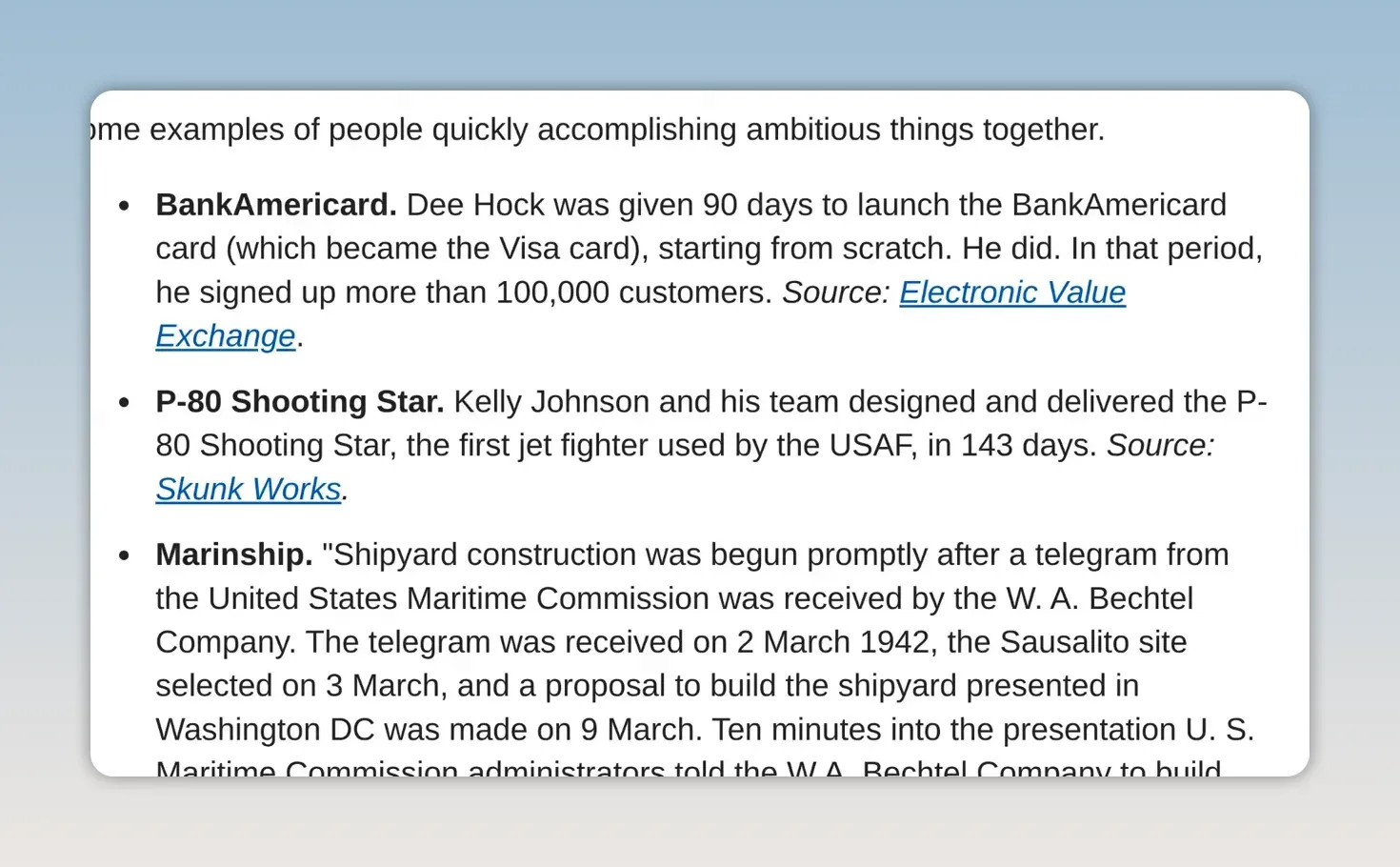
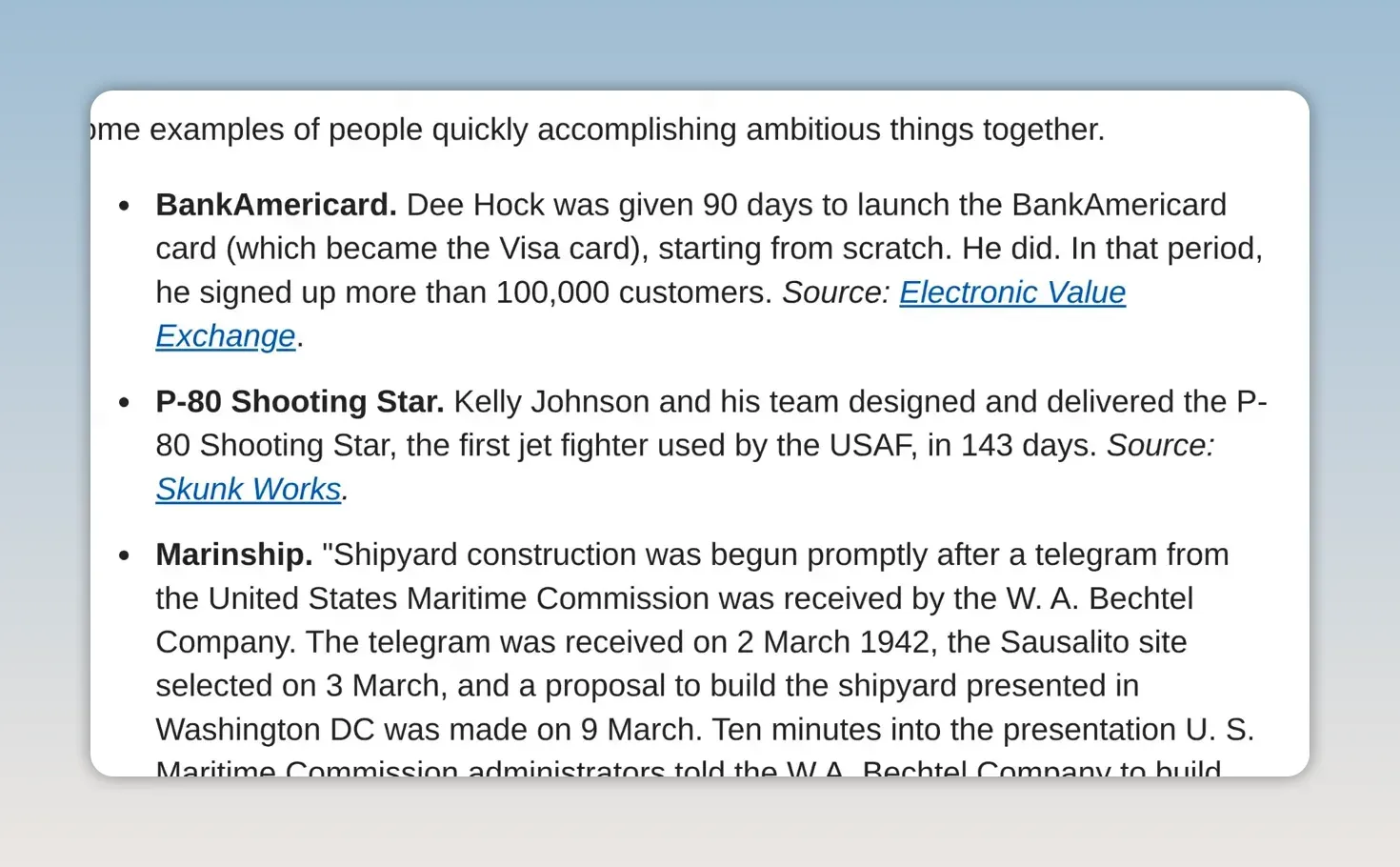
For the first, Puri mentions Stripe founder Patrick Collison’s Fast collection, which lists ambitious projects completed quickly. Its practical role is to challenge assumptions about normal timelines, not to make every project directly comparable.
For the second, Currier describes how an accelerator’s fixed demo day gives founders a clear explanation for protecting a concentrated work period. The deadline helps them negotiate distractions rather than renegotiate priorities every day.
For the third, he separates pride in an impressive artifact from commitment to business progress. A founder afraid of appearing unpolished can quietly become the release process’s longest dependency.
How can a founder stop becoming the bottleneck?
Currier’s example is to give a capable builder a clear assignment and remove unnecessary intervention, including intervention from the CEO.
He recalls an engineer proposing a 21-day game build when others expected 12 months. The engineer requested part-time design help and no idea-generating meetings with Currier. Currier reports that the product launched on day 21 and attracted three million users within two weeks.
That outcome is reported and unusually strong. The repeatable part is the agreement about ownership, support, and interruptions.
Currier also criticizes product leadership roles when professional pride encourages completeness over progress. That is his opinion about organizational behavior, not evidence that a particular title inevitably slows companies.
Roger’s take: I would audit decisions before auditing titles. Who can approve the small release? Who can add scope? Who keeps reopening settled questions? Renaming the bottleneck does not remove it.
What does emotional fluidity have to do with execution?
Currier uses emotional fluidity to describe feeling discomfort without remaining trapped in a defensive response. He believes unresolved fear, shame, and resentment interfere with fast decisions and difficult conversations.
In his account of CEO coaching, the work often centers on priorities, feelings, and necessary conversations rather than growth tactics. He mentions using spreadsheets to clarify priorities.
Puri adds a practice attributed to Tony Robbins: allowing a brief, deliberate period to experience an unpleasant emotion before deciding whether to keep dwelling on it. The discussion uses 90 seconds as a personal constraint, not a guaranteed clinical timetable.
The operating distinction is between acknowledging a reaction and letting that reaction dictate the next week’s decisions.
How can founders get useful feedback instead of polite encouragement?
Currier recommends explicitly inviting criticism and asking open-ended questions. Fundraising meetings can become opportunities to learn how experienced investors interpret the business, even when they decline to invest.
The NFX fundraising resource discussed includes more than 40 questions for investors. Its purpose is to uncover patterns, alternatives, and objections that a founder may not see from inside one company.
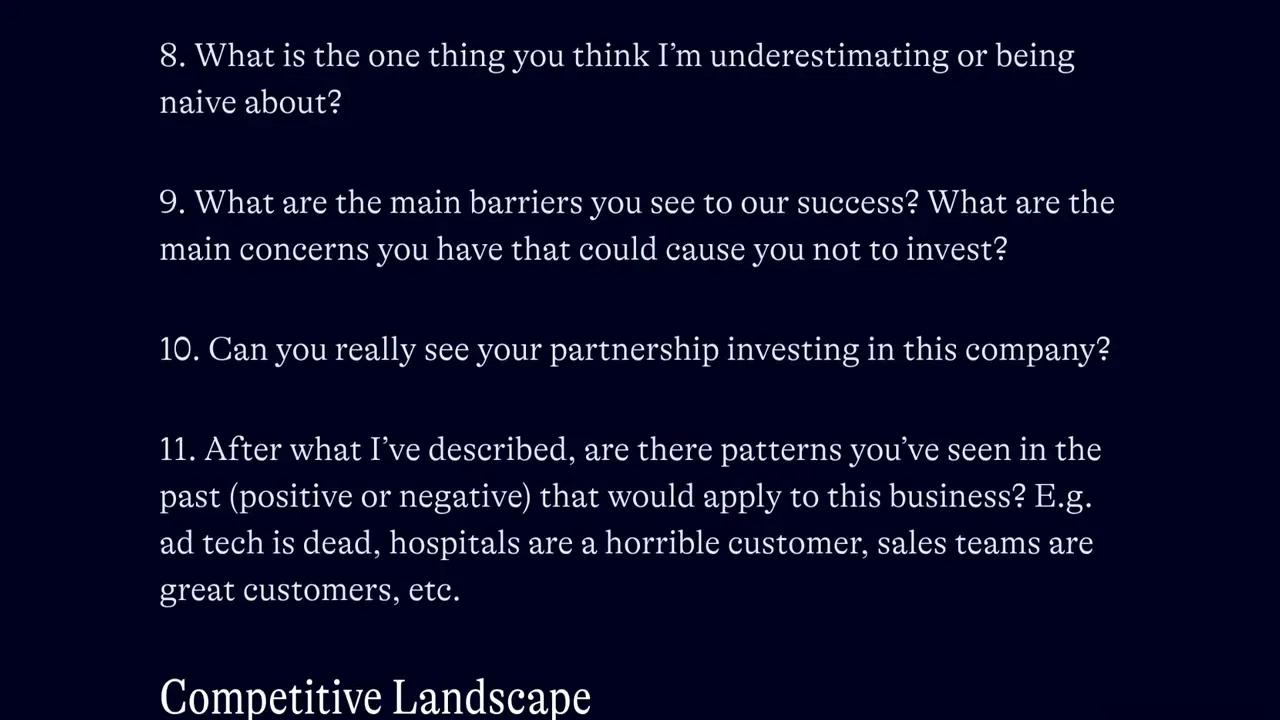
Useful question types include:
- Which other businesses does this approach resemble?
- What important consideration is absent from the pitch?
- Which assumptions deserve closer examination?
- What does the investor see differently about the competitive landscape?
Currier says he completed nine fundraisings as a founder and sometimes accumulated 80 to 100 PowerPoint versions. The point is adaptation, not collecting presentation files as a substitute for progress.
Roger’s Take: What Is Actually Replicable?
What should a solo builder take from Currier’s approach this week?
I would steal the deadline, the narrow promise, and the invitation to criticism. None requires a venture network, a famous founder, or a spectacular acquisition.
I am more skeptical of turning successful founders’ personalities into hiring criteria. Currier favors intensely competitive founders who tolerate disagreement. The practical behavior worth copying is the ability to hear an uncomfortable objection and keep making sound decisions, not cultivating conflict for atmosphere.
I would also separate financial urgency from deliberate time constraints. Currier describes founders finding clarity near the end of their runway. The useful move is to simplify earlier, not manufacture a cash crisis.
His five broader lenses provide a compact review checklist:
- Status: Is the decision serving customers or protecting appearances?
- Networks: Who can accelerate the work, and who adds friction?
- Energy: Where are money, attention, and effort going?
- Language: Does the team share a clear understanding of the promise?
- Mental models: Which assumptions about timelines remain untested?
The takeaway for how to move faster as a startup: reduce the time required to discover what deserves more investment. Faster learning is useful. Faster theater is still theater.
Next action: Write a one-page, 30-day release brief today: customer promise, minimum scope, deferred features, and the decision that real user feedback must inform.

Source: $1.5B+ Investor: “This is Why Elon Wins” by My First Million.
🧰 Build This Stack
Currier does not prescribe tools — he is an investor talking about pace. These are solid alternatives we would use to run his 30-day release loop as a solo builder, not tools he endorsed.
- Framer for a landing page that tests the promise first — a solid alternative for putting the headline in front of people before the product exists
- Lovable as an AI app builder — a solid alternative for getting a usable first version out inside a 30-day window
- Make.com to automate the busywork of collecting user feedback in one place — a solid alternative to manual copy-and-paste
- beehiiv for a founder newsletter — a solid alternative for keeping early users in the loop between successive versions
Some tools above may be affiliate links — we only list tools that fit the build.
FAQ
What is James Currier’s speed bar?
It is a person’s internal expectation of how quickly work should happen. Currier argues that founders can reset that expectation by studying faster operators and challenging inherited schedules.
Why does Currier recommend 30-day product deadlines?
A fixed deadline forces scope decisions and reduces attachment to a perfect first release. Currier uses successive launches to encourage experimentation rather than prolonged development around one idea.
Why does Currier consider founder psychology important for growth?
Currier believes fear, ego, and unclear priorities delay decisions and necessary conversations. His coaching approach focuses on those obstacles so founders can implement growth strategies more quickly.
What should founders avoid confusing with progress?
Currier and Puri distinguish customer demand from the appearance of running a company. Offices, meetings, titles, and elaborate plans do not replace building something people want and getting more people to use it.
What tools do you need to build a 30-day MVP like James Currier recommends?
Currier’s method needs a deadline, a clear promise and a way to hear from users, not a specific tool. Solid alternatives for a solo builder are Framer for the landing page, Lovable as an AI app builder for the first version, and Make.com to automate the busywork of gathering feedback.