
Breakdown: Oliver Brocato, Bustem Founder — The AI Productized Service Behind a Reported $600K/Month
Oliver Brocato’s Bustem pivoted from a self-serve SaaS nobody used to a managed AI brand protection service. What the model gets right, and what a solo builder can copy.

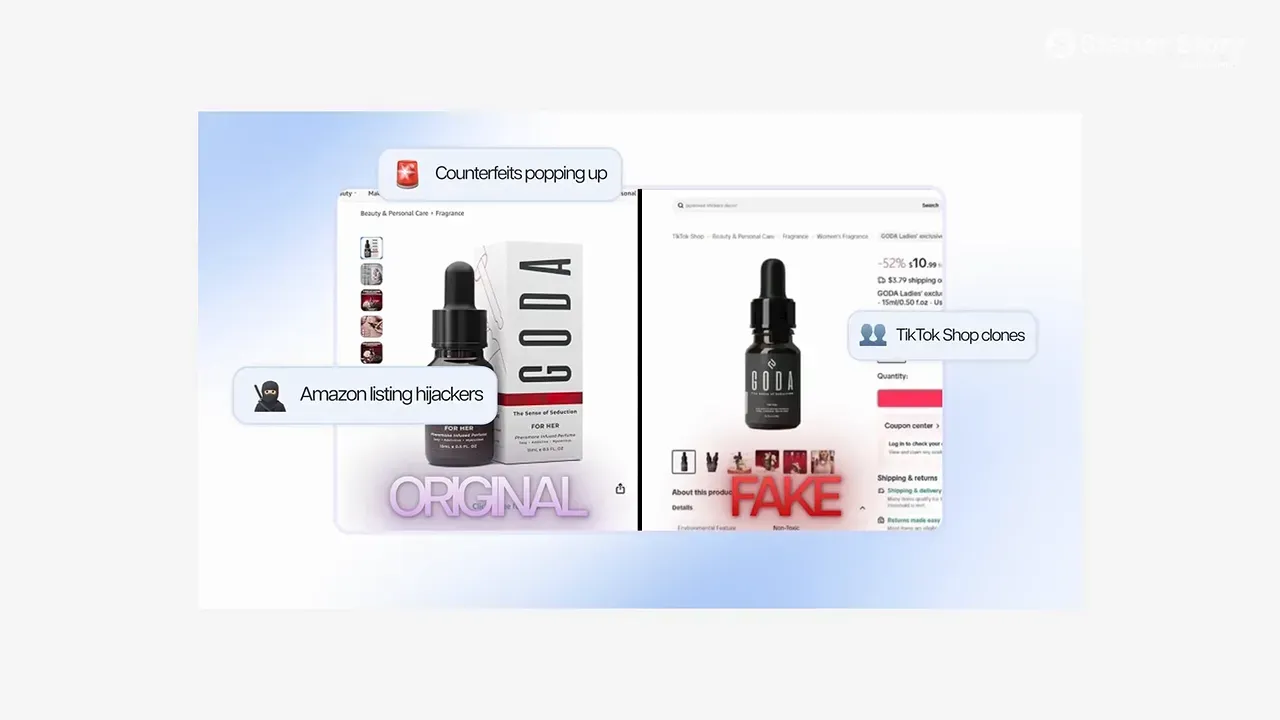
The AI productized service business model behind Bustem combines software that finds suspected copycats with people who handle enforcement for e-commerce brands. In a Starter Story interview with host Pat Walls, founder Oliver Brocato reported $600,000 in monthly revenue after abandoning a self-service approach that customers barely used.
The useful lesson is not that every app should become an agency. It is that detecting a problem and taking responsibility for resolving it are different products, with different workloads and pricing.
TL;DR
- The pivot: Around 30 brands tested Bustem’s early tool for free, but Brocato says none meaningfully used it.
- The offer: Bustem moved from identifying suspected infringements to managing the takedown process.
- The reported economics: Customers pay $1,500 to $5,000 monthly, averaging about $3,000.
- The distribution advantage: Brocato’s existing Twitter audience helped bring in early customers.
- The operational reality: Brocato reports more than 50 team members serving over 180 brands. This is not unattended software.
Bustem business snapshot
- Founder: Oliver Brocato.
- Business: Brand protection for e-commerce companies, including identifying copycats, counterfeits, and unauthorized resellers.
- Reported monthly revenue: $600,000.
- Reported funding status: Bootstrapped, profitable, and without investors.
- Reported scale: Over 180 brands and a global team exceeding 50 people.
- Location: An office on Madison Avenue in New York City.
- Initial acquisition channel: Brocato’s Twitter following.
- Named technology: Proprietary software, AI agents, scraping, automation, and Slack for client communication.
How does Bustem’s AI productized service business model work?
What does a customer actually buy from Bustem?
Bustem sells managed brand protection rather than access to a monitoring dashboard alone. Software discovers suspected misuse, while analysts and enforcement staff help move approved cases toward resolution.
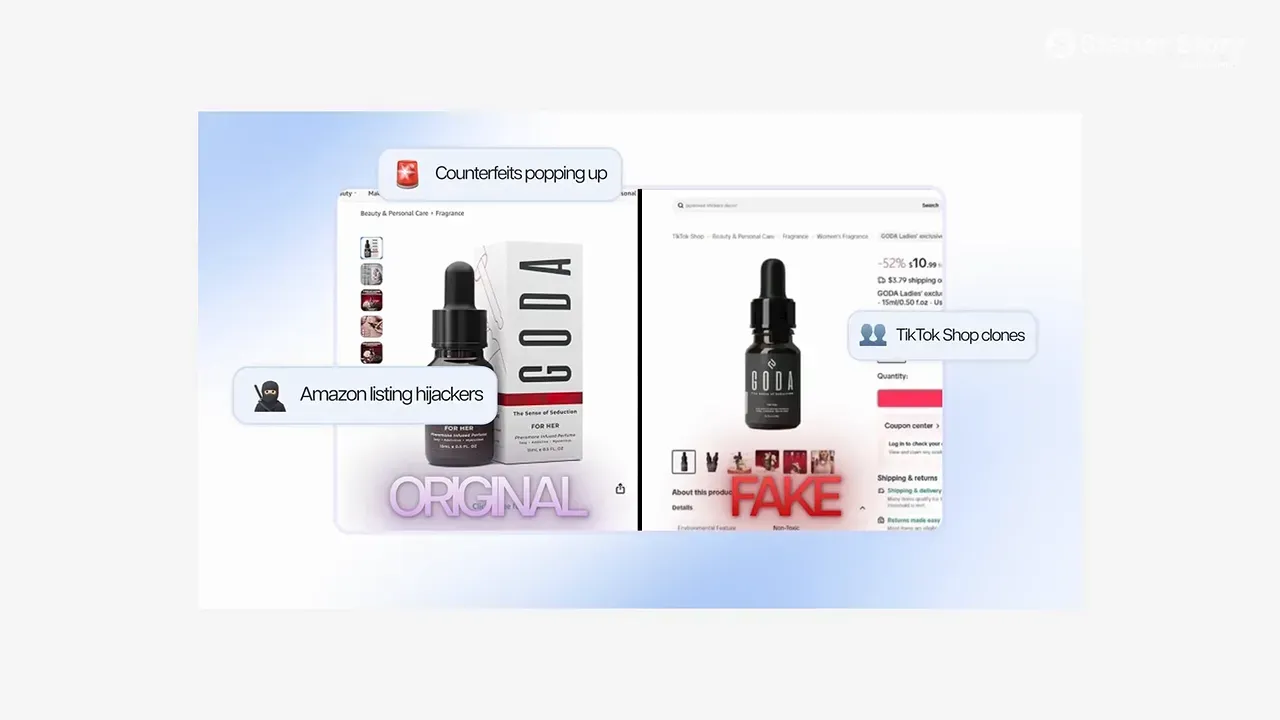
The problems include copied product photography, cloned storefronts, reused Meta ads, counterfeits, and unauthorized listings. Brocato encountered these problems while operating his previous e-commerce company, Tabs Chocolate.
The distinction matters because an alert does not finish the job. Someone still has to examine the listing, decide whether action is appropriate, submit reports, and manage the process afterward.
Bustem packages those responsibilities into a recurring service. Customers retain an approval role, but they do not have to become full-time enforcement operators.
Where did Brocato get the idea?
Brocato’s starting point was a problem he had experienced as a merchant, not a general desire to sell AI. He says successful online brands attract businesses that reuse their assets and imitate their stores.
He started Tabs Chocolate at 19 after getting into dropshipping. Brocato reports growing Tabs to $11 million in annual revenue before selling the company for an undisclosed multimillion-dollar amount.
His next-business criteria also came from that experience. E-commerce had left him burned out, particularly the pressure of continually generating sales when repeat purchasing was limited. He wanted subscription revenue, an office, and a team rather than another isolated operating experience.
That background gave him both familiarity with the customer problem and an existing audience. Neither should disappear from the explanation of Bustem’s growth.
Why did the original SaaS product fail to get used?
The original product found suspected infringers and explained how brands could report them. According to Brocato, roughly 30 beta customers received access for free, but none actually used the tool as intended.
The workflow still left customers with tedious administrative work. Bustem supplied discovery and instructions, but the merchant still had to execute the takedowns.
Brocato drew two lessons:
- Interest without payment was weak validation. Free access did not establish willingness to pay or commitment to using the product.
- The unfinished work was the opportunity. Customers wanted the problem handled, not another set of tasks.
He also concluded that the process could not be automated completely. Rather than continue insisting on a pure software business, he added service delivery.
His rejection of free beta testing is a founder’s conclusion from this experience, not proof that every free trial is useless. The narrower lesson is stronger: free signups did not validate this particular workflow.
Why keep humans in the loop instead of promising full automation?
Brocato says customers place more value on knowing real people are responsible for the work. Bustem makes that human involvement part of the offer rather than hiding it behind AI branding.
The team includes identification analysts, enforcement agents, team leads, client success managers, and a head of brand protection. Software supports discovery and automation; people support judgment, execution, and customer accountability.
Brocato did not initially want to run an agency. His decision was pragmatic: customer behavior mattered more than his preferred business category.
The positioning shift: Instead of asking brands to operate protection software, Bustem offers a team equipped with protection software. That is a more substantial promise, and a more substantial delivery obligation.
What happens after an e-commerce brand signs up?
How does Bustem find and review suspected copycats?
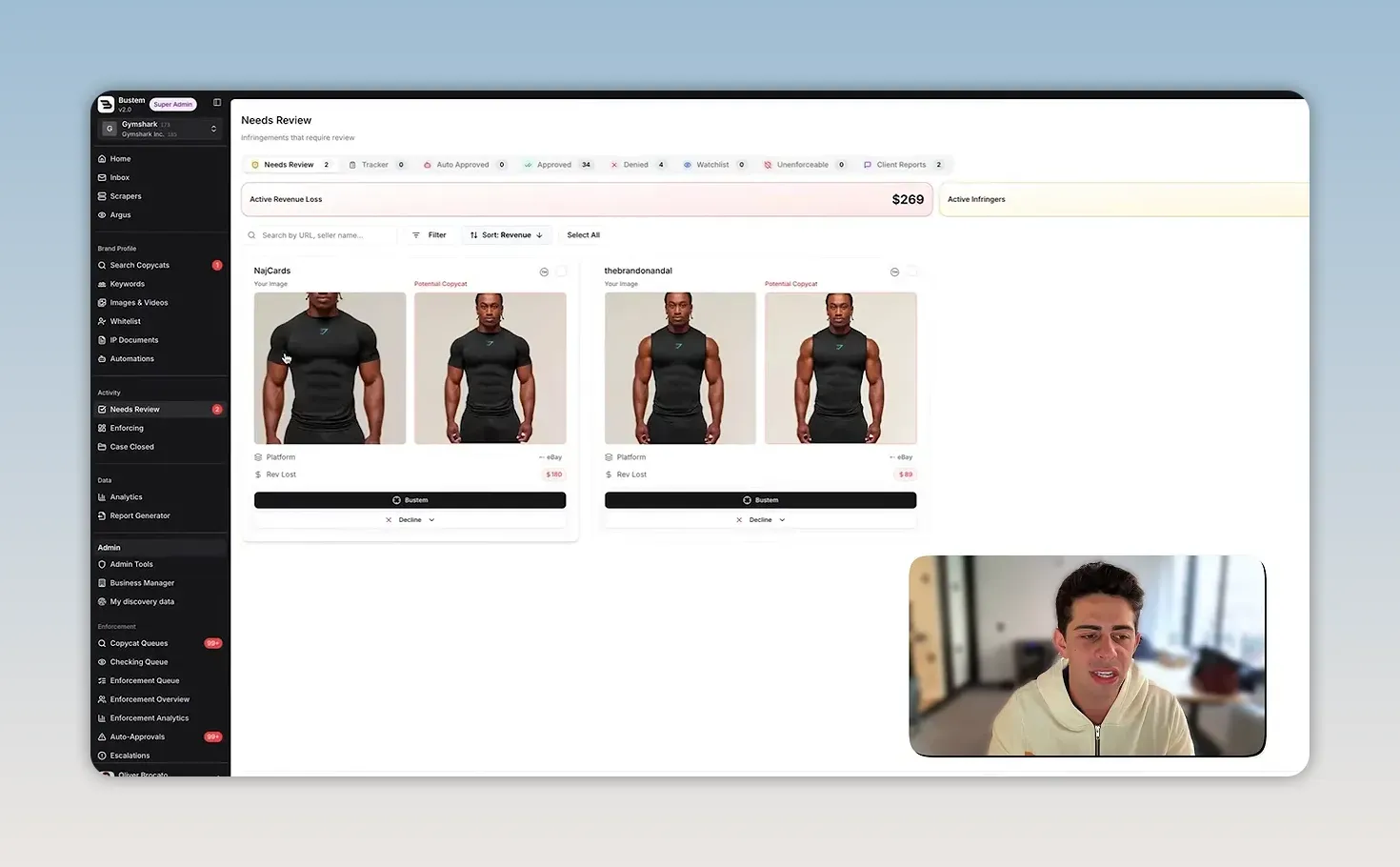
Bustem starts with the brand’s own assets and account connections, then searches for potential matches. The customer reviews suspected infringements before approved cases enter enforcement.
- Connect brand properties. Brocato names the company website, social accounts, Amazon storefront, and Meta Ads account.
- Collect reference material. Bustem gathers images, breaks advertising footage into frames, and captures keywords, brand terms, and product titles.
- Run searches. Brocato describes tens of thousands of search combinations used to identify potential misuse.
- Present suspected matches. The dashboard compares the brand’s asset with a possible copycat and provides supporting information and a source link.
- Request a decision. The brand approves enforcement or declines the case with a reason.
The approval step is important. Bustem treats a discovered match as something to review, not an automatic finding that wrongdoing has occurred.
How does Bustem handle takedowns, and are results guaranteed?
Bustem’s described approach is to pursue enforcement through the platforms and infrastructure supporting a suspected infringer. Brocato explicitly describes both successful takedowns and rejected cases.
The relevant organizations can include:
- Shopify and Amazon.
- Google.
- Payment processors.
- Domain registrars.
- Hosting providers.
Rather than only asking the suspected copycat to remove a listing, Bustem submits cases through these other channels. Cases eventually close with a takedown achieved or a takedown rejected.
That is a process description, not a guarantee of removal or a universal legal conclusion about platform liability. A service can take responsibility for pursuing a case without controlling the final decision.
Why does Bustem use Slack if customers already have a dashboard?
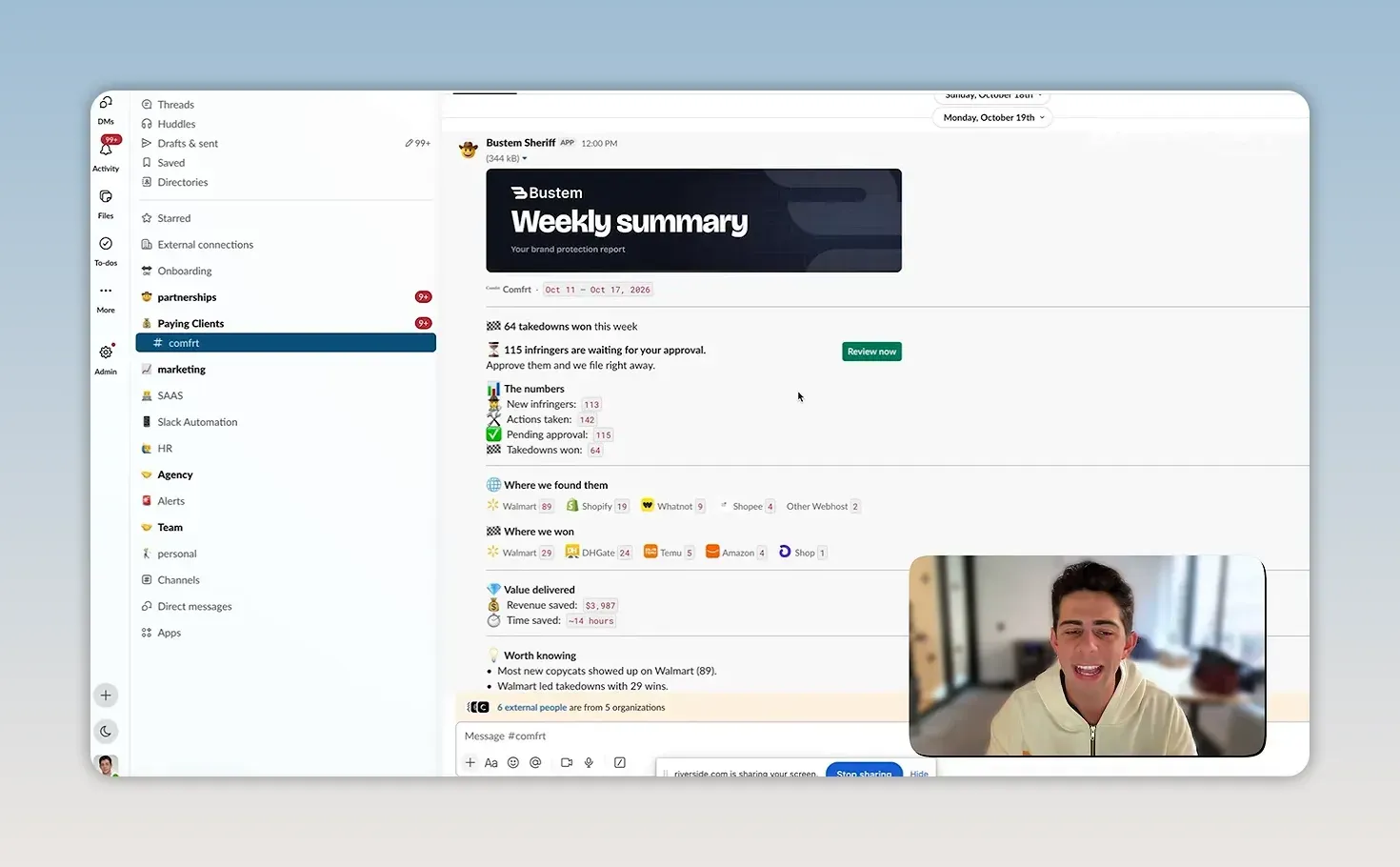
Brocato says many clients do not want to spend time inside another platform. Every client therefore receives a Slack channel and an automated weekly summary.
The summary covers newly identified infringers, actions taken, cases awaiting approval, successful takedowns, and where problems were found. Brocato also describes reporting on time saved and estimated revenue associated with suspected infringers.
Those value estimates should remain distinct from directly observed outcomes. A listing removed is a concrete event; revenue supposedly recovered requires more interpretation.
Each client also has a team lead and client success manager, with brand protection leadership overseeing delivery. The dashboard organizes work; the service layer reduces how much work reaches the customer.
How did Bustem acquire customers and price the service?
What brought in the first customers, and which channels came later?
Brocato credits his Twitter following with helping Bustem get off the ground. He does not provide a detailed first-sale timeline or initial conversion rate.
After that initial traction, Bustem diversified into:
- SEO and AI search optimization, identified as AIO.
- Cold LinkedIn outreach and cold email.
- Sales development representatives, or SDRs.
- Account executives, or AEs.
- Paid Meta advertising and paid Google advertising.
Brocato describes roughly 18 acquisition approaches overall, although he does not individually name all of them. He also does not disclose channel-level acquisition costs or returns.
The sequence is more useful than the channel count: an existing audience helped establish demand, and a broader sales and marketing operation followed. Launching every channel simultaneously is not the demonstrated starting strategy.
How much does Bustem charge, and what do the numbers prove?
Brocato reports monthly pricing between $1,500 and $5,000, with an average of about $3,000 per customer. That pricing reflects managed delivery, not simply a software login.
He also reports $600,000 in monthly revenue and says the business is profitable. Those figures are founder-reported results, not independently verified financial statements.
Several useful operating details remain undisclosed:
- Gross margin and net profit margin.
- Customer churn and retention.
- Customer acquisition cost.
- Labor and automation costs per account.
- Exact package limits and contract terms.
The reported revenue, customer count, and average price are rounded descriptions. They should not be treated as an exact financial reconciliation.
The practical conclusion is modest: this offer supports a reported four-figure monthly price. It does not establish that any AI-assisted agency can achieve the same economics.
Which parts of this model apply beyond brand protection?
What makes a good niche for an AI-assisted productized service?
Brocato recommends a narrow, repeatable problem rather than a broad platform. His example is Alia, which focused on email-capture pop-ups for e-commerce brands instead of attempting to match Klaviyo’s wider feature set.
He cites Alia’s reported growth to more than $10 million in annual recurring revenue and an approximately $60 million acquisition as an illustration of specialization. The point is focus, not an expectation that every narrow product produces an exit.
The conversation also raises project-scoped legal services, local-business reputation work, competitor price tracking, B2B lead research, and Facebook Marketplace assistance for older adults.
Those are suggested directions, not validated opportunities established by Bustem’s results. Co-host and producer Gus used ChatGPT to generate several examples. A generated idea still needs a paying customer.
A useful screening checklist, drawn from Bustem’s experience, is:
- Does the customer already recognize the problem?
- Does software reveal work that someone still has to complete?
- Can the service be scoped around one repeatable job?
- Can automation assist delivery without pretending judgment is unnecessary?
- Can progress and outcomes be reported clearly?
Roger’s Take: What is actually replicable?
What would Roger steal, and where is the hype?
I’d steal the responsibility boundary. Bustem changed who had to finish the work. The original product handed the customer a problem list; the revised offer put a team behind resolving it.
I would not copy the reported revenue target or mistake Brocato’s starting position for a blank slate. He brought e-commerce experience, a previous exit, and an audience. The current operation also reportedly employs more than 50 people. This is not a weekend automation with a billing page attached.
Where I’m skeptical is the assumption that better AI automatically produces better margins. Pat Walls argues that improving models can make service businesses more efficient. That is plausible, but no before-and-after cost figures establish the effect for Bustem here.
For a solo builder, I’d test the AI productized service business model with a smaller commitment:
- Choose one tedious task a specific customer already needs completed.
- Define what completion means and what still requires customer approval.
- Offer a paid, tightly scoped service before building more interface.
- Deliver with human oversight and record the work involved.
- Automate repeated steps only after the workflow is understood.
Today’s next action: Write one paid offer that replaces an instruction with completed work. Make the scope and customer approval requirements explicit. That tests the missing assumption more directly than another dashboard feature.
Source: How I Built It: $600K/Month SaaS by Starter Story.
🧰 Build This Stack
Bustem runs on proprietary software, AI agents and a 50+ person team. Only Slack below is part of its described setup; the rest are solid alternatives for testing a smaller version of the model.
- Slack for client communication and weekly summaries — Bustem’s own choice for clients who do not want another dashboard
- Make.com to automate the busywork of weekly client reports — a solid alternative before you can justify proprietary tooling
- Framer for a landing page that sells one tightly scoped service — a solid alternative
- Lovable as an AI app builder for a simple client approval dashboard — a solid alternative
- beehiiv for a founder newsletter — a solid alternative way to own the kind of audience Brocato built on Twitter
Some tools above may be affiliate links — we only list tools that fit the build.
FAQ
Is Bustem a SaaS company or an agency?
Bustem combines proprietary software and AI automation with managed human services. Brocato describes moving away from a self-service tool toward an agency-style model that handles enforcement.
How much does Bustem cost?
Brocato reports pricing of $1,500 to $5,000 per month, averaging about $3,000. The interview does not specify package limits or contract terms.
Did Bustem raise investment?
Brocato says Bustem is fully bootstrapped, profitable, and has no investors. These are founder-reported claims.
Does Bustem guarantee every copycat will be removed?
No universal removal guarantee is established. Brocato describes closed cases that end either in successful takedowns or rejected requests.
What tools do you need to build an AI productized service like Bustem?
Bustem combines proprietary detection software with human enforcement staff and Slack for client updates. A solo builder testing a smaller version could use Make.com to automate the busywork, Framer for the landing page and Lovable as an AI app builder for a basic client dashboard — but the paid, scoped service comes first.