
Breakdown: Marc Lou, Solopreneur Behind a Posture-Tracking Mac App That Hit $1K on Day One
Marc Lou turned a bad-posture annoyance into a tiny Mac app, launched it one afternoon, and made about $1K the same day. Here is the reusable playbook.

Most people overcomplicate launches until the idea dies in a Notion graveyard with 14 tabs open and a logo they paid too much for. Marc Lou took the opposite route. He noticed a real problem, built a tiny Mac app to solve it, launched it that afternoon, and pulled in about $1,000 the same day.
That is why this story matters. It is not another grand theory about startup genius. It is a practical example of a launch system in its simplest and most useful form. Spot a pain point. Build the thing that should exist. Put a buy button on it. See what happens.
💡 Why This Idea Was Worth Building
What problem was Marc trying to solve?
Marc did not start with market reports or some dramatic founder revelation. He started with a very ordinary problem. He spends a lot of time at a desk, like most internet people who accidentally turned browser tabs into a career. At some point he noticed the obvious: posture gets bad fast.
Not slightly bad either. More like bent-over-laptop-creature bad. The kind of posture that makes a person realize the body was not designed for twelve straight hours of clicking around online.
So he looked at the problem and had the most useful founder thought possible: if this annoys him, it probably annoys other people too. And if the app did not already exist in a simple form, maybe he should build it.
Why was the concept so simple?
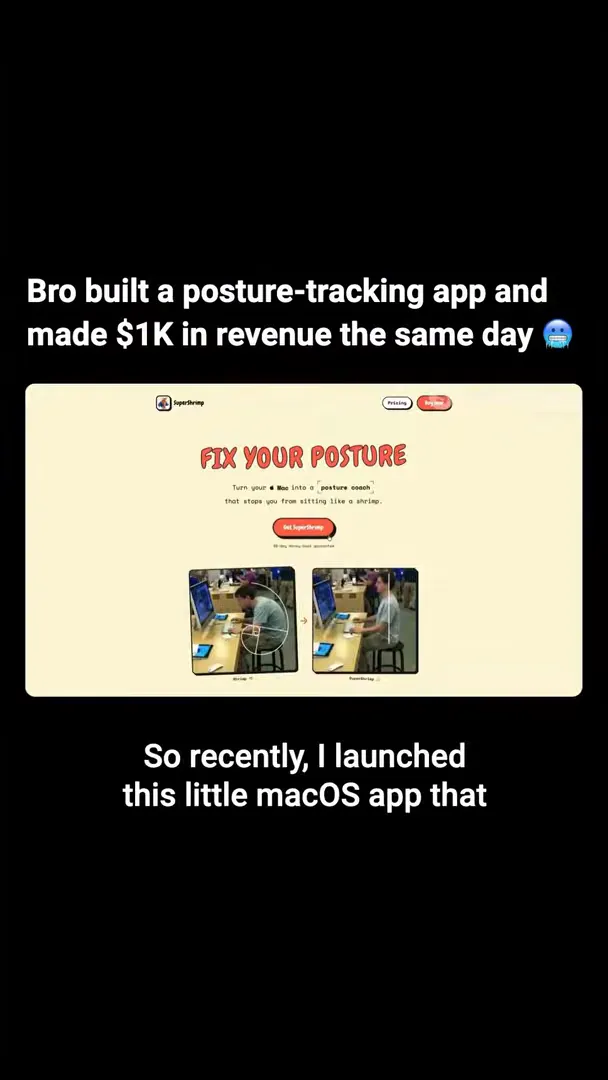
Because simple is usually the point. The app uses a webcam to check posture and gives feedback on whether the user is sitting upright or slowly folding into desk furniture. It is not trying to become a full health platform, productivity suite, meditation coach, and dental insurance provider. It does one thing.
That matters more than people think. A focused product is easier to build, easier to explain, and easier to sell. Especially for solo builders, narrow beats impressive almost every time.
🛠️ The Setup
What exactly did Marc build?
He built a small macOS app that analyzes posture through the computer camera. The promise is straightforward: if someone is sitting well, the app recognizes it. If they are slouching, the app notices that too.
That may sound tiny, but tiny is not a flaw here. Tiny is what made it shippable.
There is a useful lesson buried in that. A lot of creators and solo founders say they want an AI funnel builder or some giant all-in-one system, but what they often need is a single useful utility people will actually pay for. Marc’s app is closer to a sharp little tool than a startup fantasy deck. That is why it got out the door.
Was building for Mac a challenge?
Yes. Marc mentioned this was a different kind of app for him because he was working on macOS, which was not his usual lane. That is important because it kills a common excuse.
He did not wait until he became the world’s most qualified Mac app developer. He built anyway.
That does not mean expertise is irrelevant. It means unfamiliar territory is not a valid reason to stall forever. Plenty of good products are built by people learning in public, quietly, with mild irritation and a deadline they invented for themselves.
What made this a good solo builder project?
- It solved a problem Marc personally had.
- The value proposition was obvious in one sentence.
- It was small enough to ship quickly.
- It did not require a team, a giant budget, or ten months of planning.
- It was easy to validate because people could understand the benefit immediately.
That is the shape of a solid solo builder tech stack decision too. Not just which tools to use, but which products are worth using those tools on in the first place.
🚀 The Launch That Actually Happened
How did Marc launch it?
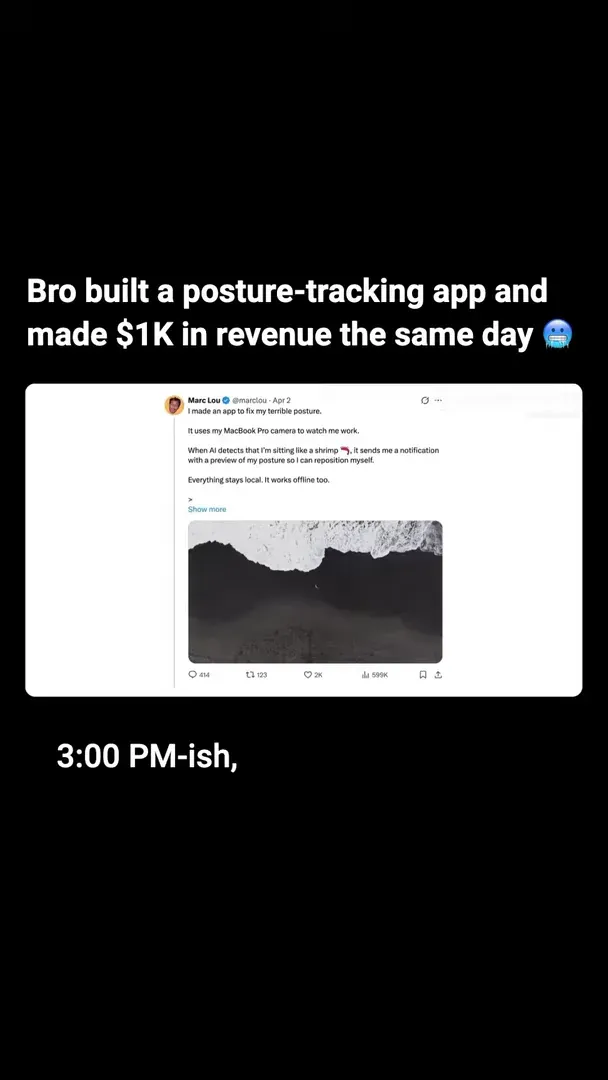
He launched in the middle of the afternoon, around 3 PM, which is refreshingly unceremonious. No countdown clock. No cinematic teaser. No fake scarcity nonsense. He just put it out.
The promotion was equally direct. He posted about it on X, then shared it across LinkedIn, Threads, and Reddit. That was enough to get the first paying customers in.
Why did that launch work?
Because the product was easy to grasp and the problem was relatable. You do not need a 40-part email sequence to explain bad posture to people who work at a computer all day. The message carries itself.
There is also another detail that gets overlooked. Marc was not launching into silence. He distributed the idea where people already spend attention. One post rarely does all the work on its own. One post plus smart cross-posting starts to look like a real launch system.
Not a bloated one. Just an effective one.
Is this what a real launch system looks like?
In spirit, yes. The phrase sounds bigger than it needs to be, but the bones are here:
- Start with a problem that is already proven by lived experience.
- Build a lightweight product instead of a huge platform.
- Use software and automation where it helps, not where it creates theater.
- Launch fast across multiple channels.
- Validate with sales, not compliments.
The useful version of an AI-powered launch system for creators is not a dashboard that looks like a spaceship. It is a practical stack that helps a person go from idea to payment quickly.
💰 What Happened After the Launch
How much revenue did the app make?
On the first day, Marc said the app brought in around $1,000 in revenue. That is a strong signal for a small utility app launched the same afternoon it went live publicly.
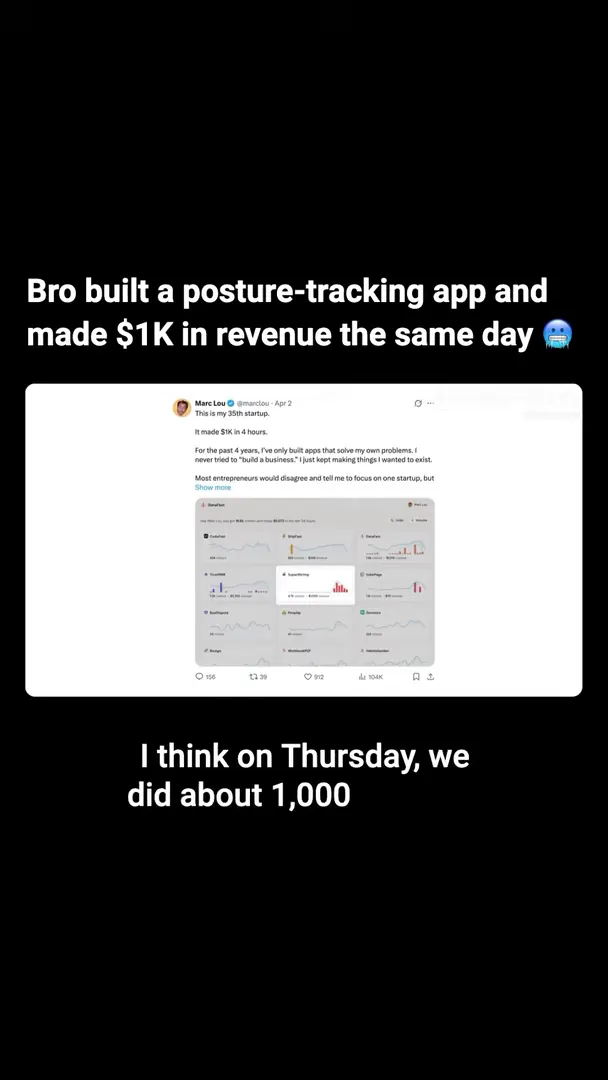
It does not mean the business was permanently solved. It does mean demand existed immediately enough to matter. And for a solo founder, that kind of early validation is gold because it answers the only question that really counts: will anyone pay for this?
What kind of response did people have?
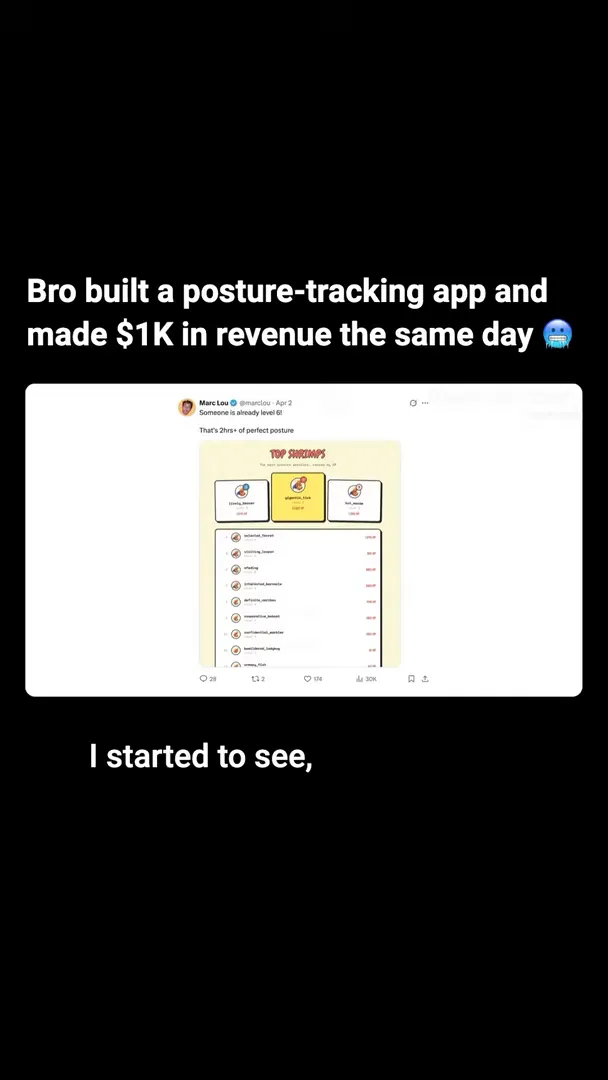
Marc got feedback quickly, and that feedback was not abstract. People started posting about the app online. That is one of the strongest forms of early momentum because it shows the product is moving beyond the builder’s own bubble.
Better still, he began seeing the app in use by customers. For most builders, that is the real payoff. Revenue matters. But seeing something you made become part of someone else’s routine is a different kind of proof.
Why is that kind of validation so important?
Because vanity metrics are cheap. Likes are cheap. Comments are often cheap too. People saying cool idea means almost nothing.
A sale means someone trusted the solution enough to pay. A user sharing the product means it delivered enough value to mention publicly. That is real feedback. Slightly messier than analytics dashboards, much more useful.
🧪 The Blueprint Hidden Inside the Story
What can creators and solo builders copy from this?
Quite a bit, actually. Marc’s process is not fancy, but it is reusable. Here is the practical version.
- Notice a recurring annoyance. The best ideas are often hiding inside a problem that keeps showing up in normal life or work.
- Build the smallest version that solves it. Not the complete ecosystem. Just the useful thing.
- Choose a format people can understand instantly. A posture checker is easy to explain. That helps every part of the launch.
- Ship before the idea gets buried under optimization. Launching fast protects momentum.
- Post where your likely customers already are. One platform is good. Several relevant ones are better.
- Measure with money and usage. If people buy and use it, keep going. If not, adjust or move on.
This is the part a lot of people miss when they try to launch with AI tools. AI can speed up research, copy, code assistance, support, and iteration. But it cannot rescue an idea nobody cares about. The product still has to solve a real problem cleanly.
What did Marc not do?
He did not spend months pretending research was progress.
He did not build an oversized product around a small problem.
He did not wait for perfect timing, perfect skill coverage, or perfect confidence. Which is good, because perfect confidence is usually just procrastination wearing glasses.
🤖 Real Talk About AI, No-Code, and Shipping Fast
Where does AI fit into this kind of launch?
The smart way to think about AI is as leverage, not magic. A good AI-assisted launch process should remove friction from building and distributing useful products. It should not become another reason to tinker endlessly with automations while nothing gets sold.
For a project like this, AI could help with:
- Generating or refining landing page copy
- Outlining launch posts for different platforms
- Summarizing customer feedback into themes
- Speeding up development with coding assistance
- Creating a quick support or onboarding layer
Useful. Practical. Boring in the best way.
The same goes for no-code startup tools. If they help get a test live faster, great. If they create a swamp of subscriptions and fragile workflows, skip them. The goal is not to win a stack comparison. The goal is to get to signal.
What is the anti-hype takeaway here?
Small software can work. Weirdly specific software can work. A product does not need venture-scale ambition to be worth shipping.
That is good news for people building on nights, weekends, or between client work and mild existential fatigue.
The internet keeps trying to convince builders that success requires a giant funnel, a large audience, and a very polished personal brand. This example suggests something simpler: a clear pain point, a useful tool, and the willingness to put it in front of people today.
🧱 What This Means for the Next Thing Someone Builds
Would this approach work again?
Not every product will hit on day one. That would be a ridiculous standard. But the method absolutely holds up.
Build from a real pain point. Keep scope tight. Launch as soon as the product is good enough to test. Share it in multiple places. Look for buyers, not applause.
That approach works because it compresses the path between idea and truth.
What should a creator test tonight?
One very boring and very effective exercise:
- Write down three annoyances that come up repeatedly in daily work.
- Pick the one that can be solved with the smallest tool.
- Describe the product in one sentence.
- If the sentence is muddy, the product probably is too.
- Build the minimum useful version.
- Launch it before it becomes a hobby project in disguise.
That is the kind of system creators actually need. Not more templates. Not more fake certainty. Just a repeatable way to test useful ideas without burning weeks on invention theater.
📌 The Real Talk
What is the biggest lesson from Marc Lou’s posture app launch?
The biggest lesson is that action beats speculation. Marc saw a problem, built the thing he wished existed, and got immediate proof that other people wanted it too.
There is no heroic mythology required here. It is just disciplined simplicity.
That is why this example is so useful for anyone trying to build their own launch system. The system is not the flashy part. The system is what makes shipping possible. A clean problem, a narrow solution, a quick launch, real distribution, real payments. Done.
Would every launch go this well? Of course not. But this is still the standard worth aiming for: build useful things fast enough that reality gets a vote.
🧰 Build This Stack
The post does not say which tools Marc used to build or sell the app, so everything below except his launch channels is a solid alternative, not his setup.
- X, LinkedIn, Threads and Reddit for distribution — the channels Marc actually used to launch
- Cursor as a coding assistant for a small native Mac utility — a solid alternative if you are working outside your usual platform, like Marc was
- Framer for your app landing page — a solid alternative for a one-page site with a buy button
- beehiiv for a founder newsletter — a solid alternative for collecting launch-day buyers so the next app does not start from zero
- Make.com to automate the busywork of cross-posting and collecting feedback — a solid alternative once launches become a habit
Some tools above may be affiliate links — we only list tools that fit the build.
❓ FAQ
Who is Marc Lou?
Marc Lou is a solopreneur known for shipping many startup ideas quickly. In this case, he built a small macOS posture-tracking app and validated it with sales on launch day.
What does the posture-tracking app do?
It uses a webcam to analyze posture and indicate whether someone is sitting upright or slouching.
How much did the app make on the first day?
Marc reported roughly $1,000 in revenue on day one after launching the app in the afternoon and sharing it across several social platforms.
Where was the app promoted?
He shared the launch on X, LinkedIn, Threads, and Reddit to get initial traction and first customers.
Why is this useful for solo builders?
It shows that a small, specific tool can be enough to generate revenue if it solves a real problem clearly and gets launched quickly.
What does a practical launch system for creators look like?
It is a lightweight way to go from problem to product to promotion using AI and automation where helpful, without turning the process into a bloated mess.
Do creators need a huge audience for this kind of launch?
Not necessarily. A relatable problem, a simple offer, and distribution across multiple relevant platforms can be enough to generate early sales and useful feedback.
What tools do you need to build a Mac utility app like Marc Lou’s posture tracker?
A focused product, a coding assistant such as Cursor, and a simple sales page are the core. Framer for your app landing page and beehiiv for a founder newsletter are solid alternatives for selling and keeping buyers in touch; Marc’s own launch relied on posting across X, LinkedIn, Threads and Reddit.
This article was inspired by this amazing video He built a posture-tracking app and made $1K in revenue the same day.. Check out more from their awesome channel.