
Interview with Matt Robinson, the Meta Engineer Who Left for His $30K/Month Golf SaaS

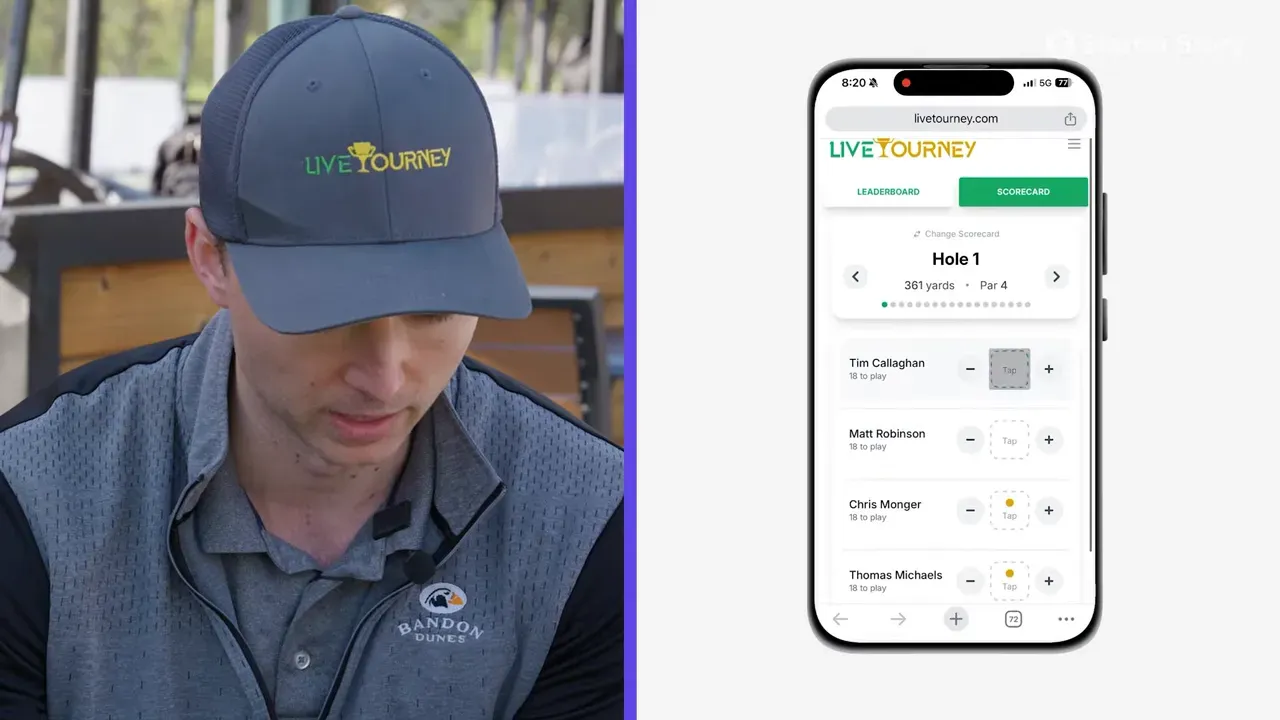
Most advice about building a business beside a full-time job is either suspiciously vague or written by someone whose definition of “side hustle” involves a team of contractors and a podcast microphone. Matt Robinson took the more useful route. He found an annoying problem inside a hobby he already cared about, built a small solution during early mornings and late nights, and grew it into Live Tourney, a golf tournament management SaaS used by roughly 150 golf courses.
The business was doing more than $30,000 a month, with about $350,000 in annual recurring revenue and an $800,000 run-rate based on its early-year performance. Meanwhile, Matt was still a senior software engineer at Meta, working on AI. Which is a fairly good problem to have, until it stops being sustainable.
For solo builders trying to assemble an AI-powered launch system for creators, a no-code project, or a full software product, Matt’s story is a reminder that the useful part is not the stack. It is finding a pain point close enough to understand, building the smallest thing that solves it, and giving it consistent time before declaring it dead. Revolutionary, apparently.
Table of Contents
- 🏌️ The Business: A Golf SaaS Built for the Messy Reality of Tournaments
- 🔎 The Setup: Find the Expensive, Complicated Thing Nobody Likes
- ⏰ The Magic: Building a Real Product While Holding a Real Job
- 🧠 The Real Talk: When a Good Job Becomes the Constraint
- 📈 What Made This a Reasonable Leap, Not Just a Dramatic One?
- 🛠️ The Useful Remix for Builders
- ❓ FAQ
🏌️ The Business: A Golf SaaS Built for the Messy Reality of Tournaments
What does Live Tourney do?
Live Tourney is a SaaS tool that helps golf courses run tournaments. It handles the part that is usually scattered across paper scorecards, spreadsheets, and a tournament organizer who has accidentally become the IT department.
Players receive a physical scorecard when they arrive. They scan a QR code, land on the tournament leaderboard, select their group or enter their card code, and record scores as they play. The leaderboard updates in real time, so everyone can see where they stand during the round.
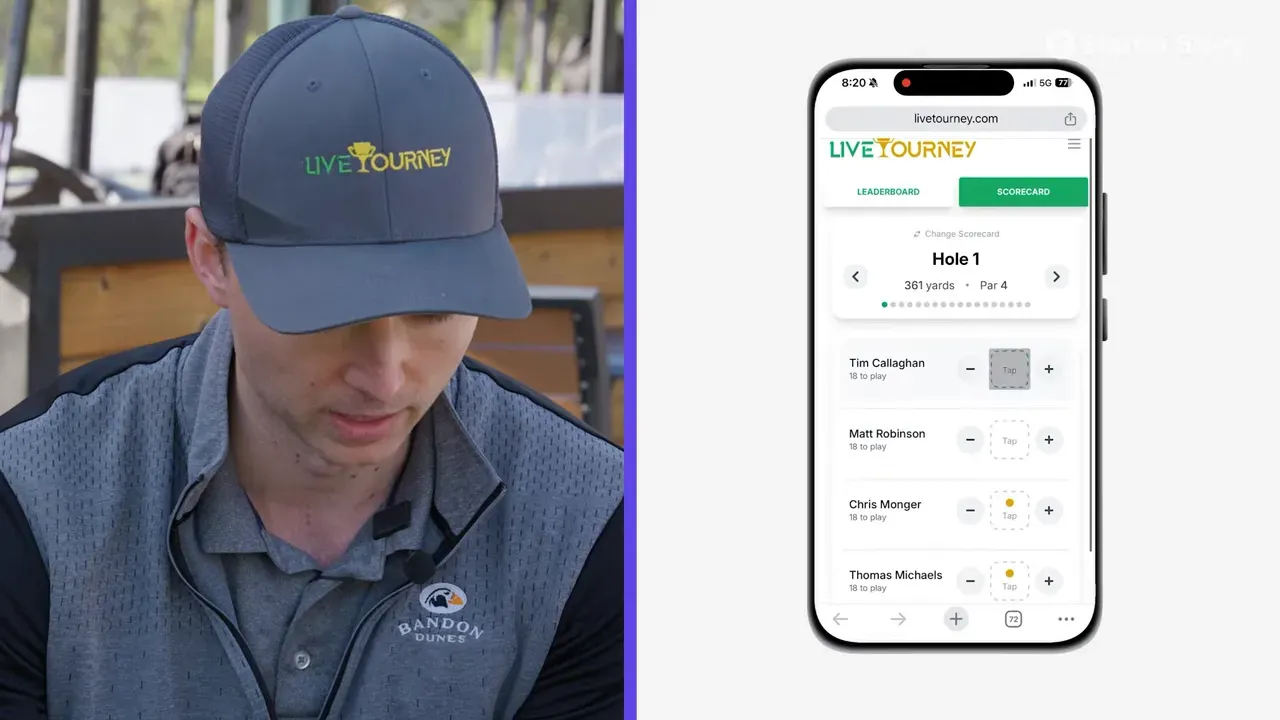
That sounds straightforward, which is usually a compliment in software. The product is not trying to turn a golf tournament into a startup pitch deck. It is removing the friction between golfers entering scores and organizers getting reliable live results.
How large had the business become while Matt was still employed at Meta?
At the time of the decision, about 150 golf courses had started using Live Tourney. The company was around $350,000 in ARR, producing more than $30,000 per month, with an approximately $800,000 run-rate based on its start-of-year growth.
Those numbers matter, but not as a permission slip to quit a job. They matter because they prove something more useful: customers were paying, the product had repeatable value, and Matt had already done the hard, unglamorous work of turning a personal project into a real business.

🔎 The Setup: Find the Expensive, Complicated Thing Nobody Likes
Where did the idea for Live Tourney come from?
Matt was playing tournaments at his local golf course and noticed the scoring process was largely manual. He knew of Golf Genius, an existing tournament management product, and asked the golf professional why the course was not using it.
The answer was clean enough to put on a sticky note: it was too complicated and too expensive.
That is the kind of sentence builders should pay attention to. Not because every complaint deserves a SaaS, but because it often points to a gap between what the market offers and what normal customers can actually adopt. Existing software had validated the category. The local course had exposed the failure mode.
What was the first version like?
Matt built the initial product for a tournament at his own course roughly four years earlier. It started as a nights-and-weekends build, then became the thing he wanted to work on first thing in the morning and last thing before bed.
There is no mystical founder lesson hiding here. Genuine interest creates endurance. When the inevitable bugs, sales friction, and feature requests show up, being close to the problem makes it easier to keep going. Building generic software for an industry a founder does not understand can work, but it is a brutal way to discover that “dentist workflow automation” was never a personality.
What technology powered the product?
Live Tourney is a web app built with Next.js for rendering and Google Firebase for the backend. That is the whole published stack. Not fifteen logos arranged like a ransom note. Not a complicated architecture diagram that exists mostly to frighten interns.
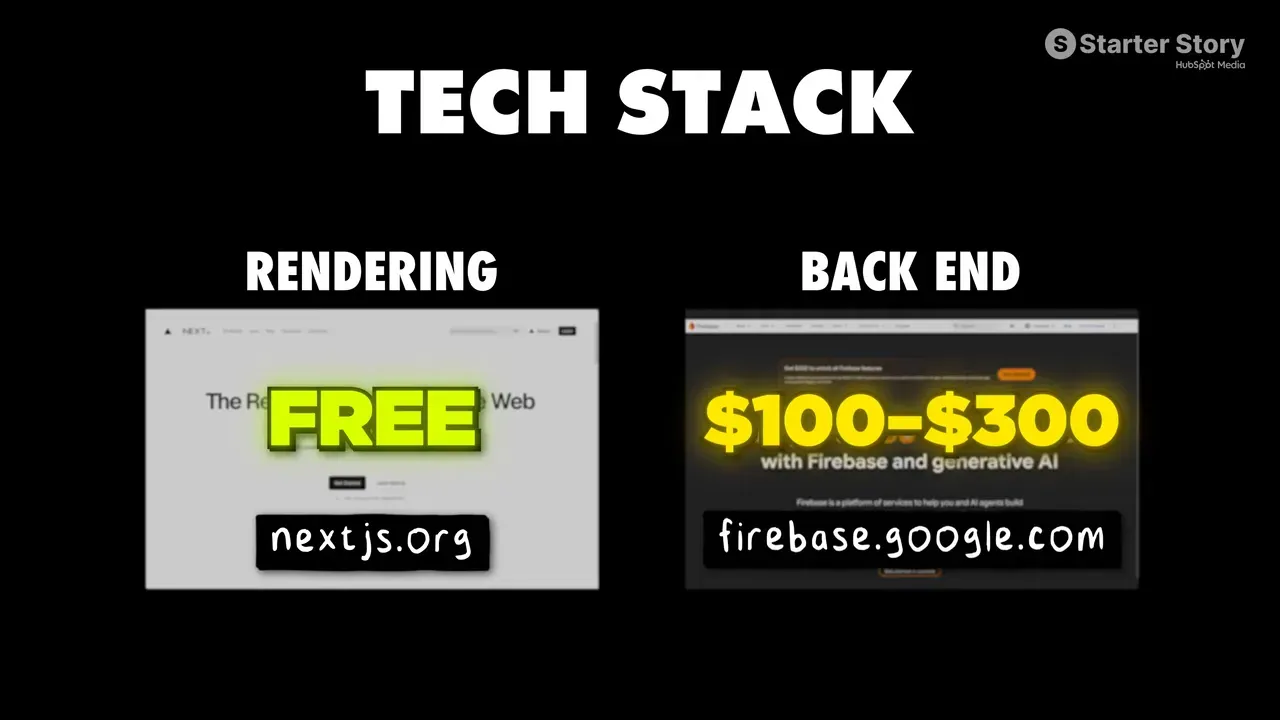
For builders using no-code startup tools or planning to launch with AI tools, the useful principle is the same: choose a stack that gets the first usable version live. The customer does not care whether the database choice was emotionally meaningful. The customer cares whether tournament scoring works while everyone is standing outside with bad reception and a scorecard in one hand.
⏰ The Magic: Building a Real Product While Holding a Real Job
How did Matt make time to build while working full time?
He treated time management as the central operating constraint, not a motivational poster. His building window was 6 a.m. to 9 a.m. He woke up early and used that block consistently.
That sounds aggressively simple because it is. The point is not that every builder needs to join the 5 a.m. productivity cult. The point is that a side business needs a protected slot that is real, recurring, and not constantly sacrificed to whatever email became “urgent” that afternoon.
Matt’s original plan was to keep both the job and Live Tourney for as long as possible. The salary and benefits lowered the risk, allowing him to grow the business at a sustainable pace rather than making every customer call feel like a hostage negotiation with rent.
That is the underrated upside of building while employed. A founder can validate an idea without needing it to become a venture-scale rocket ship by next Tuesday.
What is the practical blueprint for a side-business build?
- Use a fixed build window. Pick time that can survive a normal week. Morning blocks worked for Matt because they happened before the day could fill with chaos.
- Build around firsthand experience. Start with a place, hobby, job, or community where the problems are visible without a 30-slide market-research deck.
- Ship for one specific event or customer. Matt built for the first tournament at his own course. A real deadline beats imaginary product roadmaps.
- Prioritize customer value over feature theater. Live scoring and leaderboards addressed a clear tournament problem. That is enough to begin.
- Let revenue create confidence. The first customer and the first online payment changed the business from an idea into evidence.
An AI funnel builder can help produce landing-page copy, support drafts, and fast prototypes. It cannot create genuine market understanding on command. The fastest shortcut remains proximity to a real problem.
🧠 The Real Talk: When a Good Job Becomes the Constraint
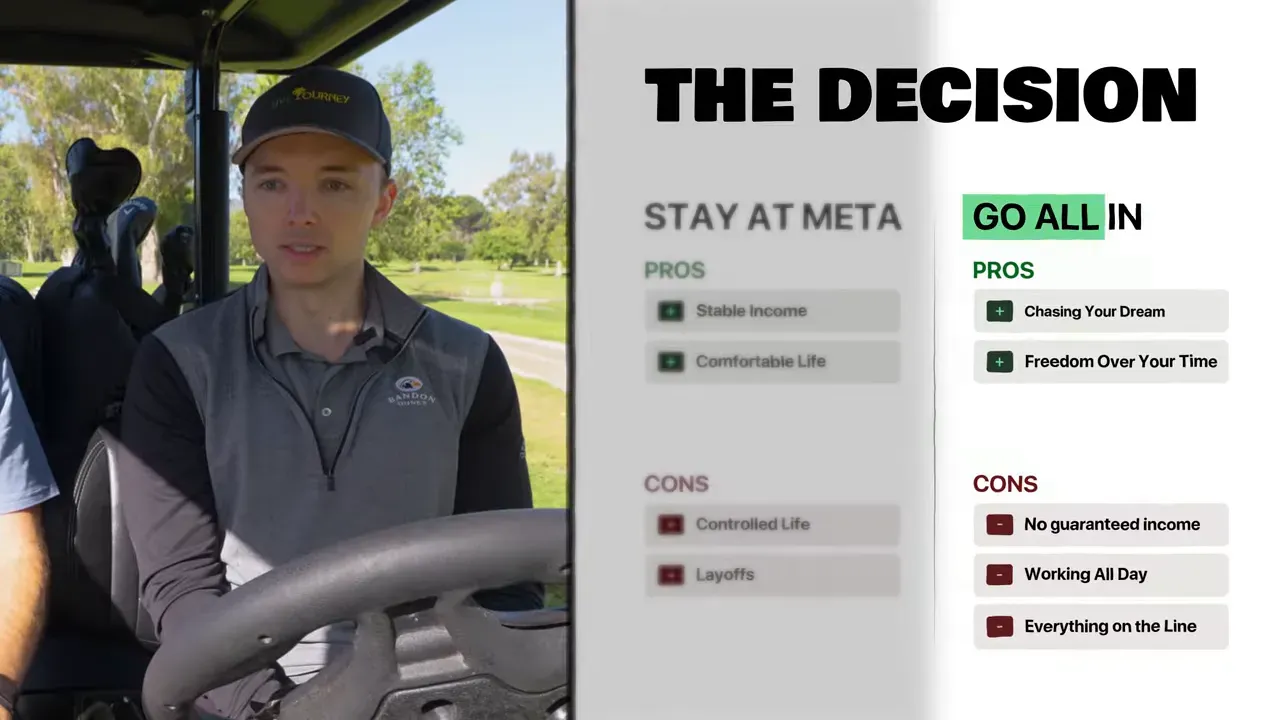
Why was leaving Meta such a difficult decision?
Matt had been at Meta for six years. It was a steady, high-quality job with a predictable schedule, salary, and benefits. Financially, staying could look like the obvious decision, particularly while working on an AI team during a period when those roles could carry major upside.
But the apparent safety of employment was not absolute. Matt had seen more than six rounds of layoffs during his time there, even though he had not been affected personally. The job was stable, not guaranteed. There is a difference.
On the other side, Live Tourney had momentum, paying customers, and a path toward becoming a substantial independent company. The issue was not whether one option had risk. Both did. The issue was which risk felt worth taking.
What made the balancing act unsustainable?
Two demanding commitments can coexist for a while. Then life adds actual life. Matt had two young children, and trying to be a senior engineer, SaaS founder, spouse, and parent was no longer sustainable at the same time.
The attraction of owning the company was not only business growth. It was flexibility. Full-time ownership could allow him to help with his children during the day, take them to the park, and choose how work fit around family. Freedom is not automatically fewer hours. It is more control over where those hours go.
Did Matt decide to go all in?
Yes. After further consideration, Matt chose to leave Meta and work on Live Tourney full time. The layoffs that happened shortly before his decision did not include him, so there was no convenient external force making the choice for him. He still had to resign intentionally.
His manager was supportive, and the fact that his manager was also a golfer probably did not hurt. More importantly, Matt’s wife supported the decision. With a family involved, this was not a solo founder fantasy sequence. It was a shared decision about income, time, risk, and the kind of life they wanted to build.
📈 What Made This a Reasonable Leap, Not Just a Dramatic One?
Was quitting the right choice because Live Tourney made $30,000 per month?
Not automatically. Another founder might reasonably keep a job until the business reaches $80,000 per month, or never leave at all. There is no magic monthly revenue number that summons a tiny founder wizard to hand over a resignation letter.
Matt’s case was stronger because several signals lined up:
- He had real, paying customers across roughly 150 golf courses.
- The product had proven its usefulness in the field.
- Revenue was meaningful and growing.
- He had already demonstrated that he could acquire customers and ship.
- The dual workload had become personally unsustainable.
- His family was aligned with the decision.
- He had a clear desire to spend his energy on the business.
The final point should not be dismissed as soft or sentimental. A founder who wakes up wanting to build the product has an advantage over one who is merely chasing a spreadsheet outcome. Motivation does not replace revenue, but it helps carry the business through the parts revenue cannot solve.
What should solo builders take away from the decision?
Do not wait for certainty. It does not exist in employment or entrepreneurship. Instead, build evidence. Get one user. Then one paying customer. Then a repeatable process. Let the business earn more of the founder’s attention over time.
Matt did not leave Meta because he had a clever idea. He left after years of turning that idea into a working product, a customer base, revenue, and a genuine operating rhythm. The leap came after the runway was built, not before.
🛠️ The Useful Remix for Builders
How can someone apply this without building golf software?
The golf part is incidental. The pattern is portable:
- Notice a workflow that people tolerate because they assume software has to be expensive or painful.
- Ask why they are not using the existing solution.
- Build a narrow version for one real customer or event.
- Use a simple solo builder tech stack, whether that is code, no-code startup tools, or an AI-assisted workflow.
- Give the project a non-negotiable weekly time block.
- Keep the day job until the business has earned a larger bet, or until the two paths clearly cannot coexist.
An AI-powered launch system for creators can be useful when it helps ship the boring parts faster. But the real work is still choosing a problem that deserves to exist, then listening hard enough to avoid building a beautiful solution for a problem nobody actually has.
Matt’s company began with one course, one tournament, and one obvious complaint: the available tool was too complicated and too expensive. That is a better starting point than most “next big thing” brainstorms. Less glamorous, more useful. Which is usually where the money is hiding.
❓ FAQ
What is Live Tourney?
Live Tourney is a golf tournament management SaaS for golf courses. It lets players scan a QR code, enter scores on a web app, and see tournament leaderboards update in real time.
How did Matt Robinson find the idea for his SaaS?
Matt played in local golf tournaments and discovered that his course did not use an existing tournament product because it was too expensive and too complicated. He built a simpler version for an event at his own course.
What tech stack did Live Tourney use?
Live Tourney was built as a web app using Next.js for rendering and Google Firebase for the backend.
How did Matt build a SaaS while working at Meta?
He protected a consistent early-morning work block from 6 a.m. to 9 a.m. and built the business during those dedicated hours while keeping his full-time job.
When should a founder quit a full-time job for a SaaS business?
There is no universal revenue threshold. A more grounded decision considers customer traction, revenue, growth, personal capacity, family circumstances, risk tolerance, and whether the business has demonstrated a real path forward.
This article was inspired by this amazing video Should I Leave Meta For My $30K/Month SaaS?. Check out more from their awesome channel.