
Interview with Jake Glacer, the Solo Builder Behind a $50K a Month Alarm Clock App

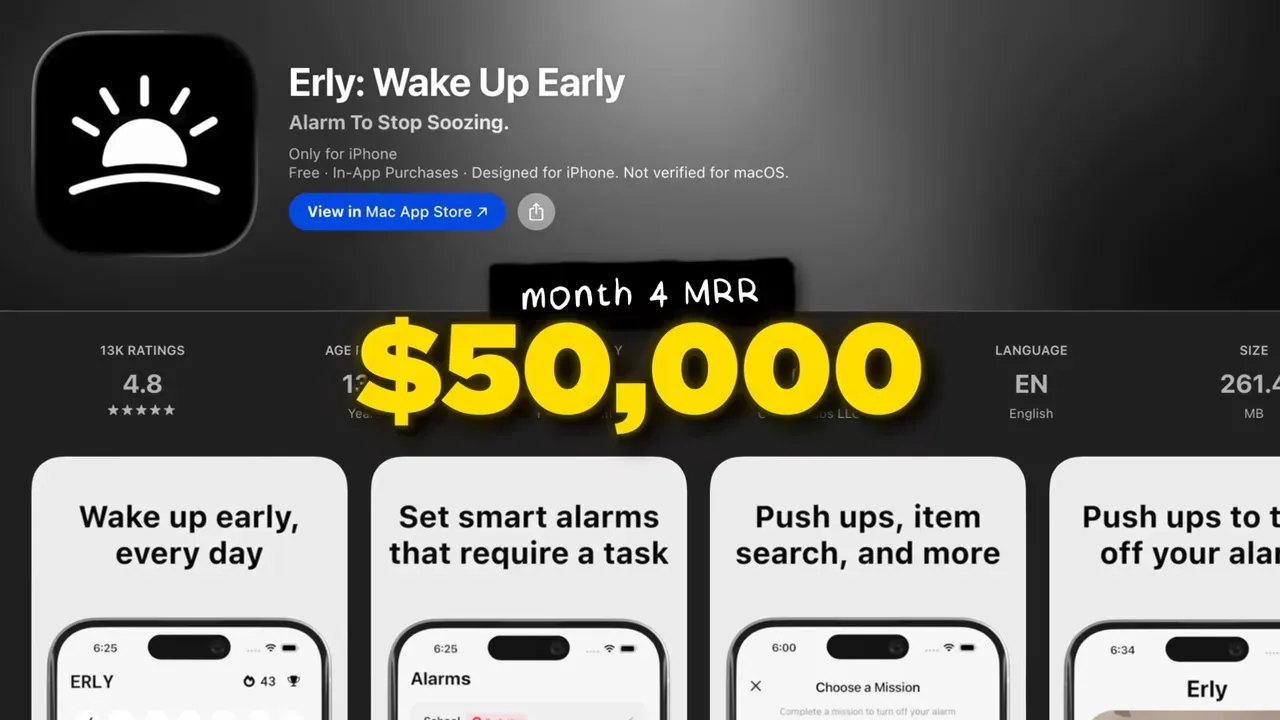
Table of Contents
- 😵 Why This Even Matters
- 🛠️ The Setup
- 💡 The Idea
- ⚡ The Build
- 📈 The Marketing
- 🤖 The Product and AI Piece
- 🧠 The Real Talk
- ❓FAQ
- 🔧 Final Takeaway
😵 Why This Even Matters
Why should anyone care about a simple alarm clock app?
Because this is the kind of business story people usually miss while chasing bloated startup ideas, giant AI wrappers, and tool stacks that look like an IT department had a panic attack.
Jake built an AI-powered launch system for creators in spirit, even though the product itself is not some grand futuristic machine. It is an alarm clock app called Erly that helps people wake up by requiring pushups to turn the alarm off. That is it. Painfully simple. Weird enough to spread. Useful enough to pay for.
And that simplicity is the point.
Too many solo builders think success comes from complexity. More features. Better branding. More dashboards. More "ecosystem." Usually it just means more time spent building something nobody asked for.
Jake took the opposite route. He found a painful problem, wrapped it in one instantly understandable feature, and pushed distribution hard from the beginning. Four months later, the app was doing more than $50,000 per month.
That makes this less of an app story and more of a blueprint for anyone trying to launch with AI tools, move fast, and not disappear into a cave with a half-finished product.
🛠️ The Setup
What exactly did Jake build?
He built Erly, a wake-up app with a dead simple promise: do pushups to turn off your alarm.
The pricing model is also straightforward:
- Free trial
- $29.99 per year
- $9.99 per month
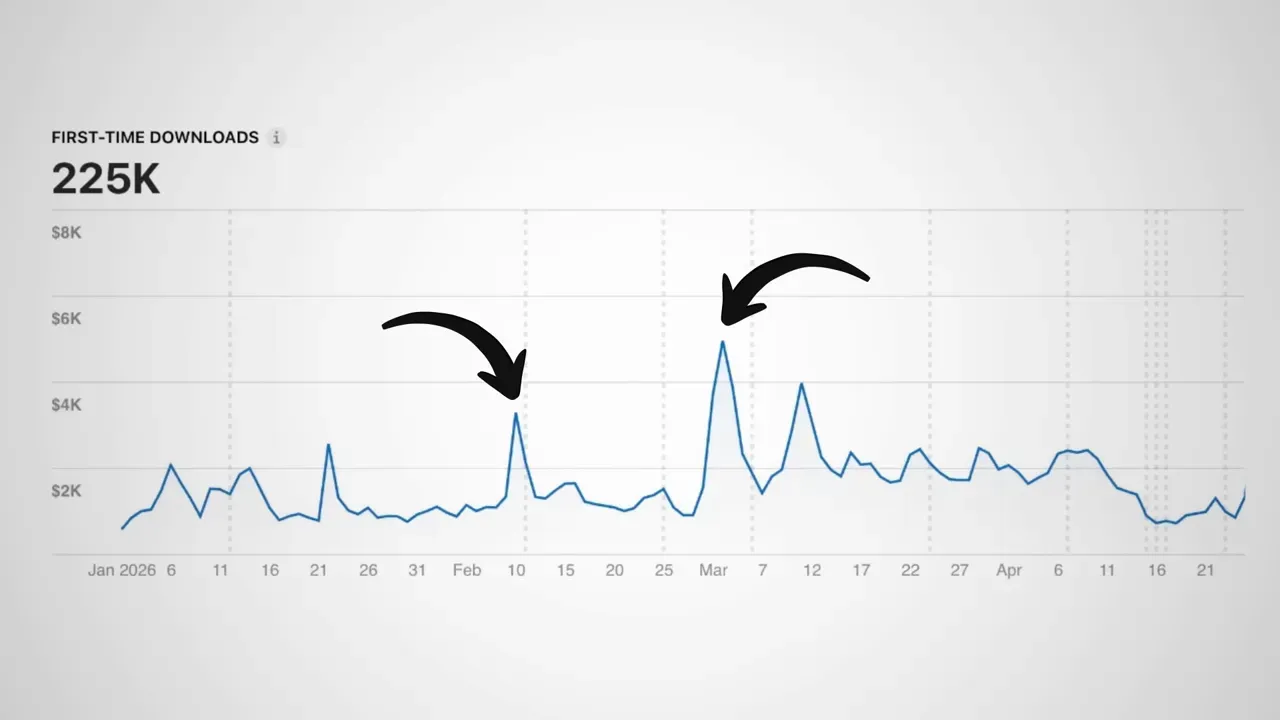
In a recent 28-day period, the app generated more than $50,000 in sales and had roughly 50,000 first-time downloads in the last 30 days. Total downloads passed 200,000 within the year.
Why did this idea work when there are already a million alarm apps?
Because "alarm app" is not the hook. The hook is the mechanism.
Most bad app ideas die because nobody can explain them in one sentence without sounding like they are applying for venture funding. This one explains itself instantly. If someone struggles to wake up, they get it in about two seconds.
It also carries a built-in visual. Pushups as the unlock mechanic are naturally viral. That matters more than people want to admit.
What tools powered the business?
Jake ran this mostly as a solo builder, using a stack that is refreshingly practical. No ceremonial nonsense. Just tools that do jobs.
App stack:
- Firebase for database, authentication, and cloud functions
- Superwall for paywalls and subscriptions
- OpenAI for AI API usage
- Mixpanel for in-app analytics
- Claude Code for building
Marketing and ops stack:
- Influencer tracking software for managing creator deals
- Sideshift for sourcing and managing UGC creators
- Instantly for mass outreach emails
- Cal for meetings
- Agree for contracts
- Google Sheets for keeping the whole circus together
- QuickBooks for accounting
- 1Password for password management
If anyone wants a useful phrase for this, this is a very clean solo builder tech stack. Light, functional, and good enough to get real revenue without pretending to be enterprise software.
💡 The Idea
Where did the app idea come from?
From an actual problem, which is still somehow underrated.
Jake was struggling to wake up early himself. His workaround was to text a friend the night before and promise to send a pushup video by 6 a.m. the next morning. That gave him accountability, but it was clunky. It worked just enough to reveal there might be a real product hiding inside it.
The first version of the app was not even an alarm app. It was more of an accountability tool for logging whether he woke up when he said he would.
That version got built in about three weeks.
Then came the more important realization. The product existed, but the angle was weak. It was not obvious enough, not viral enough, and not easy enough to market.
What changed the direction?
Timing and platform shifts.
Apple introduced AlarmKit, which made it possible to connect directly to the native iPhone alarm system. Before that, a lot of alarm apps had to rely on workarounds and gimmicks. That is a rough position to be in when the core promise is reliability. Nobody wants a startup-friendly alarm that occasionally forgets it has one job.
Once the native alarm integration became possible, the idea got sharper fast. Now the app could do something genuinely useful and dependable while still keeping the viral twist.
What is the actual framework for finding ideas like this?
Jake's framework is simple enough to fit on a sticky note:
- Solve a painful problem
- Solve it in a simple way
- Add a novel or viral feature if the concept is not naturally shareable
That is one of the cleaner filters for anyone building an AI-powered launch system for creators or any mobile product. If the pain is real, people pay. If the value is simple, content performs better. If the feature is novel, marketing gets easier.
He also had one useful test for identifying pain: if the problem runs through someone’s mind at least once a day, there is a good chance it matters.
Waking up early was that kind of problem. In college, it was a recurring conversation. After launch, people kept reacting the same way: either they needed it, or they immediately knew someone who did.
⚡ The Build
How fast did Jake build the app?
Fast enough to make perfectionists uncomfortable.
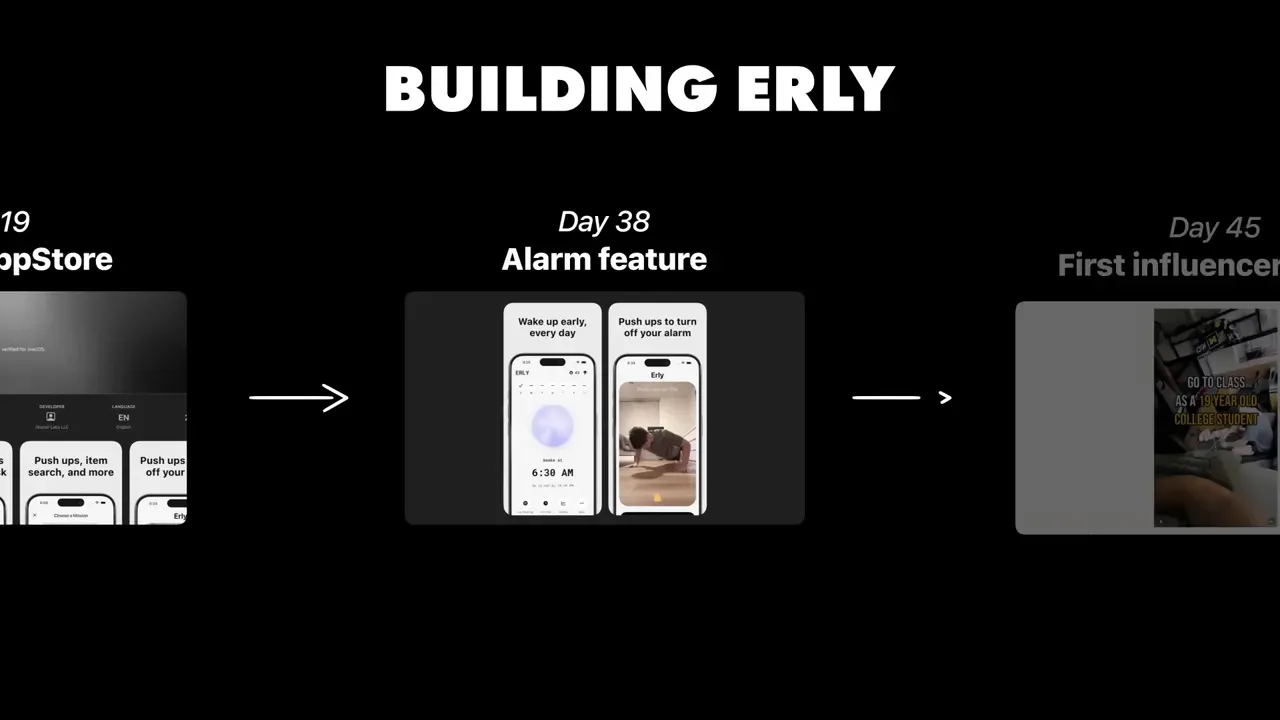
From first commit to App Store launch took about 19 days. Then the alarm feature went live roughly 19 days later. So the full version people now recognize took a little over a month.
That speed was not random. It came from a clear rule: ship the minimum version fast and validate distribution even faster.
Why move that quickly?
Because building was not the real uncertainty.
Jake already believed he could make the product. The bigger unknown was whether he could get attention and convert that attention into downloads and revenue.
This is the part many builders get backwards. They polish features for six months as if the app is a Fabergé egg. Then they launch to twelve people and a cousin who says "cool man."
Jake treated marketing as the test, not the afterthought.
His first influencer video went live just seven days after launch. That is the move. Not because it is glamorous, but because it answers the only question that matters: does the market care?
How quickly did validation show up?
Pretty quickly.
- First influencer video went live seven days after launch
- First $1,000 in revenue came three weeks after that video
- First $30,000 month happened in month three
- First $50,000 month happened in month four
That is not a normal outcome, obviously. But the mechanics are still useful. Build small. Test distribution early. Double down if the market responds.
📈 The Marketing
What was the real growth strategy?
Influencer marketing on TikTok and Instagram, with obsessive focus on fit.
Jake was not looking for generic reach. He was looking for creators already making day-in-the-life or lifestyle content where the app could appear naturally. That distinction matters.
If the product feels stapled onto the content, it behaves like an ad. If it fits the creator’s usual format, it behaves like part of the story. One of those gets ignored. The other gets comments asking for the app name.
What did a strong creator fit look like?
Think college routines, early morning content, self-improvement habits, and daily structure. The perfect creator already has a "wake up" moment in the content. Add a phone alarm and pushups, and the product demo is basically built in.
That is why the app was so easy to market. It solved a pain point while also making for interesting short-form content. That overlap is gold.
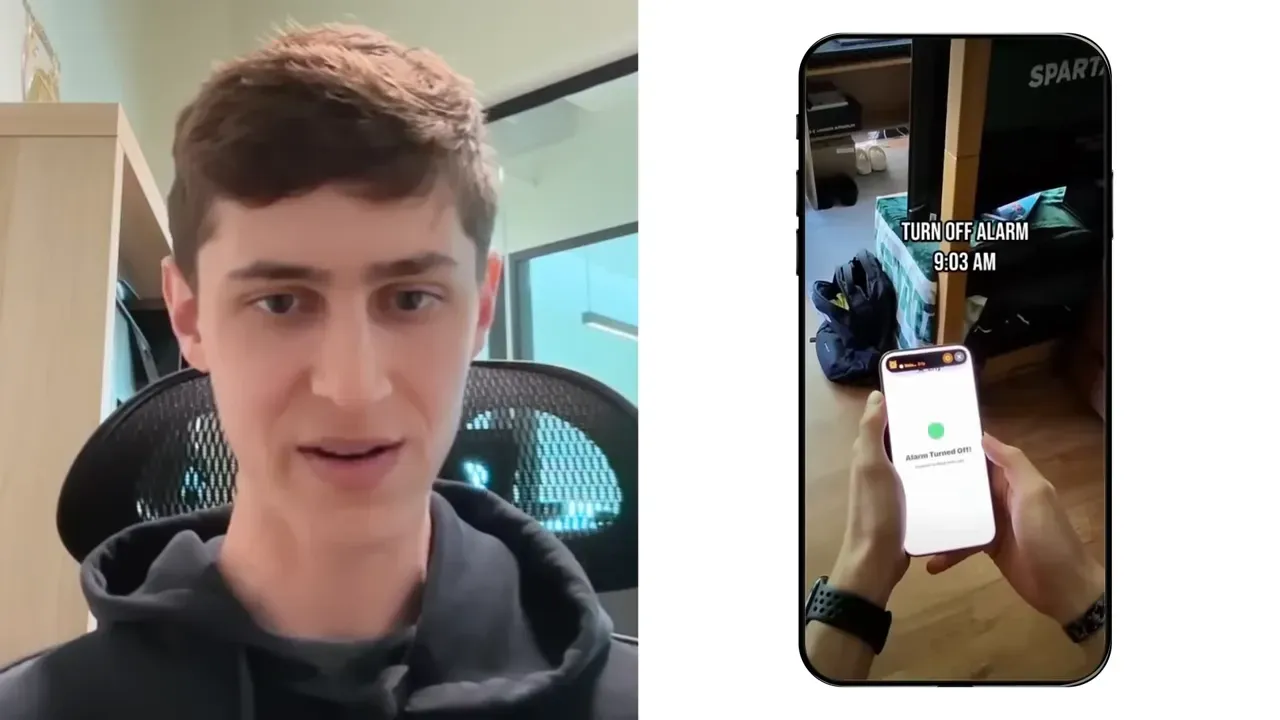
What made those videos convert?
A few things:
- The app showed up early in the content
- The use case was obvious without explanation
- The content still felt like the creator’s normal style
- The pushup mechanic created curiosity immediately
- People asked for the app name in the comments
That last piece matters more than it sounds. A lot of conversions happened because people saw the app in context, then looked it up after checking the comments. Not elegant. Very effective.
How were influencer deals structured?
Usually as multiple videos per month with a view guarantee.
That gave Jake a way to cap risk. Instead of paying for vibes and hoping the algorithm felt generous, he was paying based on guaranteed attention.
He generally paid around a $2 to $3 CPM off the guaranteed views.
The model was also power-law driven. Many videos did fine. A few did extremely well. Those big outliers carried a lot of the return.
How did he track performance if comment-driven installs are messy?
By not pretending attribution was cleaner than it was.
Jake kept it simple:
- Track views on each creator video
- Monitor download and conversion spikes
- Compare timing against historical performance
- Treat the system like a black box with enough signal to make decisions
That is not perfect attribution. It is real-world attribution.
He also accepted that some individual creator deals would lose money. That is part of the game. The goal was not to identify a mathematically pristine winner every time. The goal was to make the portfolio profitable.
🤖 The Product and AI Piece
Where does AI come into this?
The AI is not the headline. It is the helper.
That is probably one of the healthiest ways to use AI right now.
In Erly, the app analyzes whether the person actually completed the pushups. That means the AI is supporting the core behavior, not replacing the entire product with a chatbot wearing a fake mustache.
Jake also used modern AI tools to build faster. That matters for solo builders trying to launch with AI tools without hiring a full team or sinking months into development.
So if someone is searching for an AI funnel builder, this is not that. But if they want a smarter way to launch with AI tools, this is absolutely the pattern worth studying: use AI to compress build time and strengthen the product, then spend most of the energy on distribution.
How does the app actually work?
It is delightfully simple:
- Create an alarm
- Set the time and repeat schedule
- Choose the mission, in this case pushups
- When the alarm goes off, open the app and start
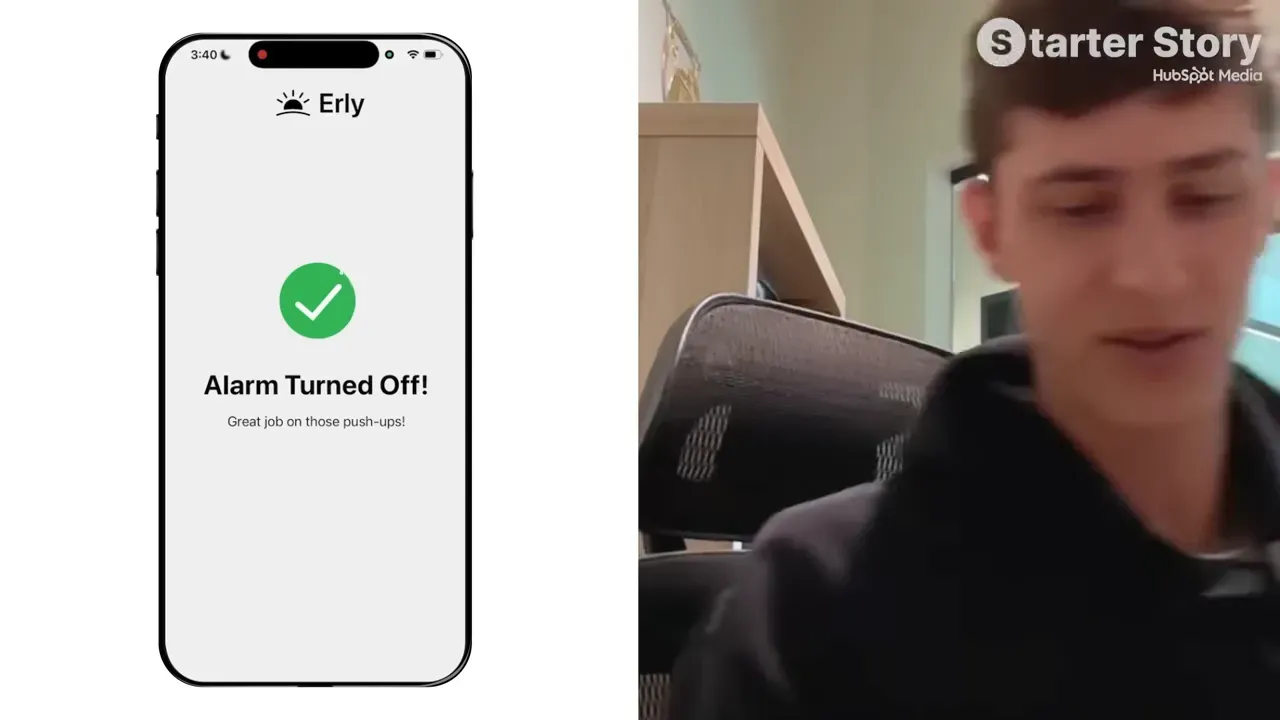
- The app records and analyzes the pushups
- If the motion checks out, the alarm turns off
No endless menu maze. No productivity manifesto. No six-part onboarding that asks about "preferred circadian identity."
Just: wake up, do the reps, earn silence.
🧠 The Real Talk
What is the biggest lesson from all of this?
Marketing beats building.
Not because product quality does not matter. It does. The app still has to work. But the market does not reward hidden craftsmanship. It rewards useful things that get seen.
Jake said the most valuable skill right now is top-of-funnel marketing. Hard to argue with that. Building is getting easier every month. Distribution is still the bottleneck.
If nobody knows the app exists, it may as well not exist.
Would this approach work again?
Yes, but not by copying the exact app.
The reusable part is the system:
- Find a recurring pain point
- Make the solution stupidly easy to explain
- Add a visual or viral mechanism
- Ship an MVP fast
- Test marketing immediately
- Scale what gets attention and revenue
That is the real AI-powered launch system for creators hiding underneath the story. Not some overpriced course with 84 automations and a Notion dashboard shaped like regret. A clear product plus fast distribution loops.
What should solo builders actually test tonight?
Three things:
- Write down one problem that annoys them every day
- Describe the simplest possible app that solves it in one sentence
- Ask whether the idea would make a naturally interesting short-form video
If the answer is yes, that is worth prototyping.
If the answer is no, it may still be a fine product, but marketing will probably be harder. Better to know that early than after six weeks of "feature exploration."
❓FAQ
How much revenue did Erly reach and how fast?
Erly reached more than $50,000 per month in about four months after launch.
What makes Erly different from other alarm apps?
The core differentiator is simple and highly visual: users must do pushups to turn off the alarm, and the app analyzes whether they actually completed them.
How long did it take to build the first version?
The initial version reached the App Store in about 19 days. The alarm feature was added roughly 19 days later.
What was the main growth channel?
The main growth channel was influencer marketing on TikTok and Instagram, especially with lifestyle and day-in-the-life creators where the app fit naturally into existing content.
How were influencer deals priced?
Deals were typically structured as two to four videos per month with a view guarantee, usually priced around a $2 to $3 CPM.
What is the key lesson for solo builders?
Limit scope, solve a painful problem simply, and focus heavily on top-of-funnel marketing. The build matters, but distribution matters more.
🔧 Final Takeaway
If someone only remembers one thing from this interview, what should it be?
Do not confuse effort with leverage.
Jake did not win by building the most advanced app in the category. He won by finding a painful problem, packaging the solution into a simple and inherently marketable feature, and putting distribution first.
That is the part most builders skip because it is less comfortable than tinkering. But it is also the part that turns a side project into revenue.
For anyone trying to build an AI-powered launch system for creators, the takeaway is not "make an alarm app." It is this: use modern tools to build quickly, keep the concept brutally clear, and put serious reps into getting attention. The market does not pay extra for hidden complexity.
And frankly, that is good news.
This article was inspired by this amazing video This Insanely Simple App Makes $50K/Month. Check out more from their awesome channel.