
Interview with Tom Holliday, the Founder Who Turned a Simple Booking Widget Into an $85K AUD Monthly Business

Most builders do not need another AI-powered launch system for creators, a 47-tab “idea validation” dashboard, or a $97 course explaining that pain points are important. They need a real problem, a clear offer, and enough nerve to put it in front of people who might say no.
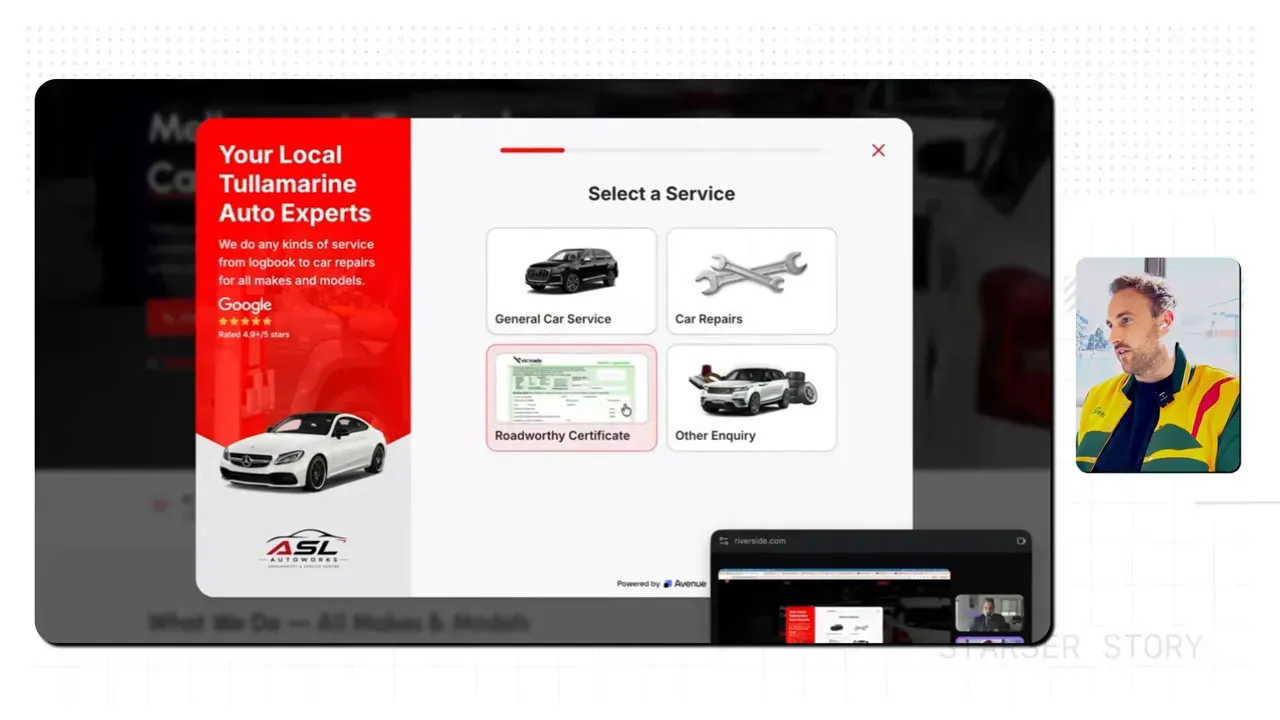
Tom Holliday and his brother built Avenue, a website embed for trades businesses such as mechanics and electricians. The product gives customers a visual, branded way to select a service, choose a time, and book or enquire without picking up the phone. Avenue now reports roughly $85,000 AUD in monthly revenue.
It is a useful case study because the product is not pretending to reinvent business software. It fixes one annoying, expensive gap: service businesses lose opportunities when booking requires calling, emailing, or waiting for office hours. The build is simple. The execution is not.
Table of Contents
- 🧱 The Problem Was Hiding in Plain Sight
- 🔧 Building Without a Technical Background
- 🚪 The Unfashionable Growth Strategy: Walking Into Businesses
- 🛠️ Let the Market Choose the Niche
- ⚙️ The Tech Stack Behind the Widget
- 💸 Sell Before Building the Cathedral
- 🧠 The Real Takeaway: Build the Boring Thing That Pays for Itself
🧱 The Problem Was Hiding in Plain Sight
What exactly is Avenue?
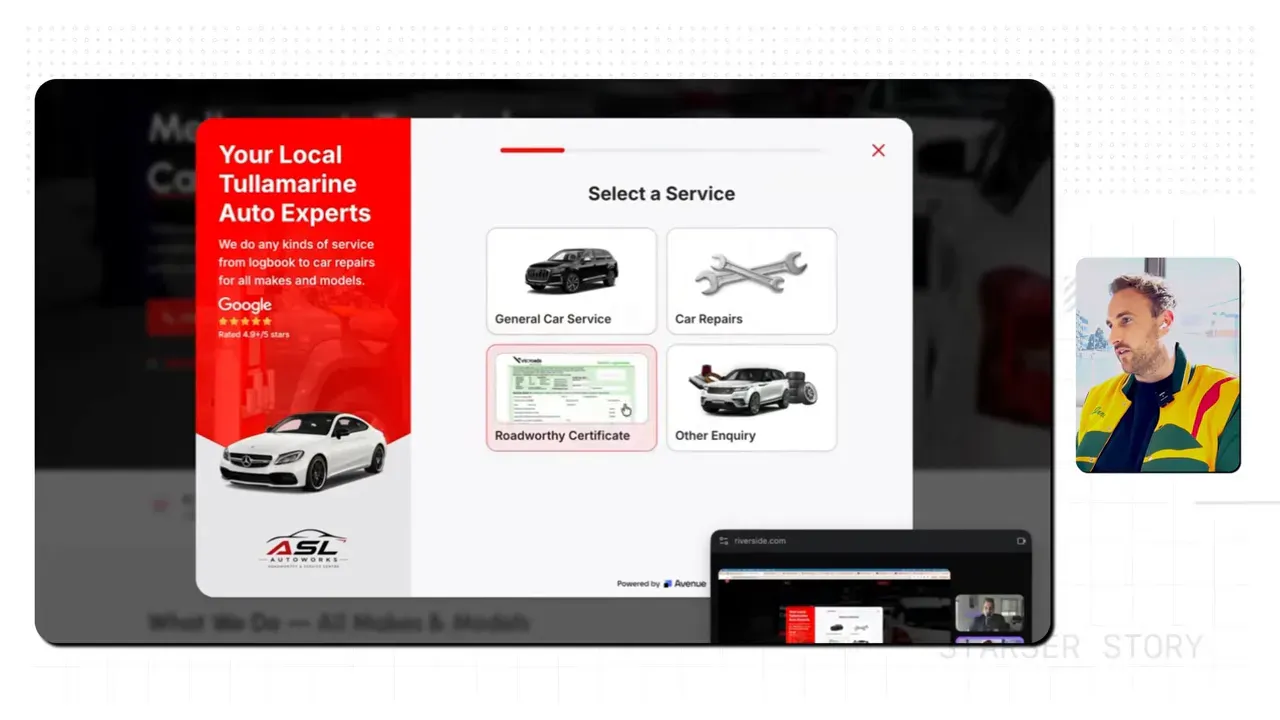
Tom explains that Avenue is a website widget embedded directly on a business’s existing site. It presents a company’s services visually, then guides a customer through a booking or enquiry flow in that company’s own branding.
For a mechanic, that may mean selecting the type of vehicle, choosing a service, choosing a date and time, then providing the details needed to make the booking useful. For other trade businesses, the path can lead to an enquiry instead. The important part is that the customer does not need to call just to explain what they need.
Avenue also connects with Google Reservations, meaning the booking experience can begin from a business’s Google profile as well as from its website. Separate entry points, one system behind them. That is the sort of boring integration work that customers rarely praise directly, but absolutely notice when it is missing.
What customer problem does the widget solve?
Tom frames it as an old problem with a painfully obvious answer: someone has money and wants to buy from a service business, so why must the process begin with a phone call or an email?
For many trades businesses, the answer is historical inertia. The team is on jobs. The office is busy. The phone rings when nobody can answer. A customer gives up, finds another provider, and the business never even knows the lead existed. Great system, if the goal is to make purchasing needlessly difficult.
Avenue gives the business a way to collect bookings and enquiries outside normal hours. More importantly, it makes the service menu legible. Instead of a vague “contact us” form that creates admin work for everyone, the customer can specify what they want at the start.
Why does a seemingly small widget have real business value?
Because a small interface can sit directly in the path between intent and revenue. A booking button is not exciting in the abstract. But if it helps a workshop turn missed calls into confirmed jobs, its value is very easy to understand.
That is the central lesson. A product does not need to be original to be useful. It needs to reduce a meaningful bit of friction for a customer who already has a reason to spend money.
🔧 Building Without a Technical Background
How did Tom get into software in the first place?
Tom left school early and got a low-paying first job. That experience pushed him into obsessing over business models and the mechanics of making money beyond trading hours for dollars. Software stood out because it could continue creating value after the initial work had been done.
That did not make the path glamorous or automatic. He had no coding background and had not designed a product himself. What he did have was persistence, prior business experience, and the willingness to figure out who needed to be involved to make the idea real.
His mindset was fairly direct: if other attempts had worked to some degree, why not start this one too? Not a bad operating system. Better than waiting for a magical feeling of readiness, which has delayed more products than bad code ever did.
What did the first version of Avenue look like?
In February of the previous year, Tom worked with a developer friend to create an MVP. The goal was narrow: prove that the experience could be embedded naturally into a client’s website.
Once the basic layout started to come alive, he committed more heavily. Avenue hired a lead designer to improve the customer-facing experience, a head developer to build the backend, and a frontend developer to make the product work cleanly on the web.
Tom is honest about the timing. The team was hired before the business had revenue. On paper, he calls that a terrible idea and does not recommend copying it casually. In practice, it gave Avenue the polish and technical confidence needed to sell larger businesses.
How was the early team funded before revenue existed?
Tom had operated a marketing agency for roughly a decade, with more than 70 website-hosting clients still paying recurring fees. He used that income to fund the transition into Avenue.
That is not a universal blueprint. It is a reminder that “bootstrapped” does not mean “built with zero resources and a motivational quote.” It can mean using cash flow from one stable business to take a measured swing at another.
For solo builders putting together a solo builder tech stack, the practical takeaway is to separate validation from expansion. An MVP only needs to prove that the core experience can work. Bigger costs should follow evidence, not enthusiasm wearing a productivity hat.
🚪 The Unfashionable Growth Strategy: Walking Into Businesses
How did Avenue get its first customers?
Tom and the team went door to door. They walked into local businesses, introduced the product, and demonstrated it in person. At first, they showed Avenue on an iPhone. Prospects kept assuming it was a standalone app, which was not ideal when the whole point was that it lived on a company’s website.
The team changed one small thing: they used iPads. Suddenly, prospects could see the product in a larger website context and understand that it could be branded for their own company. They also printed brochures to explain the offer more clearly.
That adjustment got early traction because it made the product easier to grasp. It sounds almost offensively simple, but product comprehension is a growth lever. If someone cannot understand what they are buying in 20 seconds, better targeting will not rescue the conversation.
Why did face-to-face sales work?
The offer was concrete. Avenue could show a business that it was probably missing bookings outside of normal operating hours, then demonstrate how the widget captured those leads. There was no need for a long sermon about digital transformation, thankfully.
In-person selling also built local credibility. After enough visits, larger businesses began to recognize the Avenue team. That recognition made the company feel established before it had the usual list of large-client connections.
Small clients became the route to bigger ones. They created proof, referrals, and visibility. The early sales work was not scalable in the neat little spreadsheet sense, but it was extremely useful in the “people actually bought this” sense.
What should builders learn from going door to door?
Tom says it is intimidating to show someone a product that has absorbed serious effort. They may like it. They may tell the builder exactly why it makes no sense. Both outcomes are useful.
The real mistake is treating harsh feedback as a personal attack. A direct “this does nothing for me” can reveal that the niche is wrong, the offer is unclear, or the product is one adjustment away from being valuable to a neighboring type of business.
Some businesses that did not need Avenue themselves referred Tom toward businesses that did. That only happens after the product leaves the laptop and enters the real world. A no-code startup tools list cannot do that part for anyone.
🛠️ Let the Market Choose the Niche
Did Avenue begin with trades and mechanics in mind?
No. The team initially showed the product to almost any open business, including music studios, repair shops, and trade businesses. They did not choose the niche from a pristine market map. They found it by putting the product in front of people and noticing who cared.
Trades businesses responded most strongly. Mechanics and electricians were direct, practical, and willing to pay only if the system could justify itself. That was exactly the feedback loop Avenue needed.
Tom describes these operators as no-nonsense customers. If the widget does not generate value, it does not stay. That filter pushed Avenue toward tangible outcomes instead of temporary hype, which is a healthy constraint for any product.
How should a founder choose a niche?
Tom’s answer is less romantic than most niche-selection frameworks: show the product to everyone reasonable, listen carefully, and follow the demand.
A niche is not always discovered by thinking harder. It is often revealed by patterns in real conversations:
- Who understands the offer immediately?
- Who can describe the pain without being coached?
- Who asks about price instead of needing a 40-minute explanation?
- Who gives useful, specific objections?
- Who refers the product to another business that needs it more?
That is a better starting point than inventing an elaborate persona and hoping it eventually develops a budget.
⚙️ The Tech Stack Behind the Widget
What tools does Avenue use to operate?
Avenue runs its hosting through AWS, which Tom identifies as a core business cost. The team uses Slack for communication and Google Workspace for day-to-day operations.
AI and messaging are also part of the operational layer. Avenue uses Vapi for AI voice credits, Twilio for SMS, Lusha to find highly specific leads, and Claude as a regular working tool. The reported Twilio spend is substantial because SMS is a meaningful part of how the product communicates.
This is the more realistic version of an AI-powered launch system for creators or service businesses: not sprinkling AI over a landing page and declaring it a revolution, but placing automation where it reduces actual workload or improves response time.
AI voice, SMS, lead sourcing, and language models are useful here because they connect to the business’s real workflow. The tool only matters if it helps a service business capture, qualify, or manage opportunities more effectively.
How does the booking experience work in practice?
The journey can start from a Google booking button, which takes a customer into the client’s branded booking flow. The customer selects what they need and progresses through the relevant choices.
If they exit that flow, Avenue can bring them back to the business’s website, where the embedded version is also available. The booking system and the website widget feed into one central process, rather than making the business manage disconnected channels.
💸 Sell Before Building the Cathedral
What is Tom’s clearest advice for founders?
Sell before building. Yes, it has been said many times. It has also been ignored many times, usually by someone spending six weeks perfecting an empty-state screen.
Tom’s test is refreshingly practical: explain the problem being solved. If someone asks how much it costs and is genuinely prepared to hand over money, there may be something worth pursuing.
Customers do not care how much effort went into a product if it does not solve a problem they value. Slightly rude, completely true.
What is the practical version of selling before building?
It does not require pretending the product exists when it does not. It means selling the outcome and validating the commitment before investing in the full machine.
- Identify one frustrating, recurring problem in a specific business workflow.
- Describe a clear outcome, not a pile of features.
- Show a simple mockup, prototype, or manually delivered version.
- Ask what the buyer would need to commit.
- Quote a price and pay attention to whether the conversation becomes real.
- Build the smallest version capable of delivering the promised result.
For someone trying to launch with AI tools, that is the useful order: customer problem first, automation second. AI can speed up a system that works. It can also speed up the construction of something nobody wants. Both are technically impressive. Only one gets renewed.
🧠 The Real Takeaway: Build the Boring Thing That Pays for Itself
What makes the Avenue story worth copying?
Not the exact widget. Not the monthly revenue screenshot. Not even the tool stack.
The copyable part is the sequence:
- Notice a frustrating path to purchase.
- Build a simple mechanism that removes friction.
- Show it directly to real businesses.
- Let blunt feedback shape the niche.
- Improve the explanation when prospects are confused.
- Keep the value tied to an outcome the customer can understand.
Tom did not begin with a perfectly selected audience or a technical background. He began with a problem that would not leave him alone, then did the uncomfortable work of taking the solution into the market.
That is the durable lesson for anyone building an AI-powered launch system for creators, a booking product for local businesses, or something much smaller. Find the point where money is trying to move but the process is stupidly difficult. Fix that first. The rest can earn the right to exist later.
❓ FAQ
What does Avenue do?
Avenue provides an embeddable, branded booking and enquiry widget for service businesses, particularly trades such as mechanics and electricians. It can also connect with Google Reservations.
How did Avenue get its first customers?
The team used door-to-door sales, demonstrating the product to local businesses. Switching from an iPhone demo to an iPad helped prospects understand that the product was embedded into their websites.
What revenue does Avenue report?
Tom reports that Avenue reached approximately $85,000 AUD in monthly revenue.
What is the main lesson from Tom Holliday’s build?
The main lesson is to validate willingness to pay before investing heavily in a product. A direct customer commitment is stronger evidence than admiration for an idea.