
Interview with Shaan Puri, My First Million Co-Host, on AI Business Opportunities Beyond Software

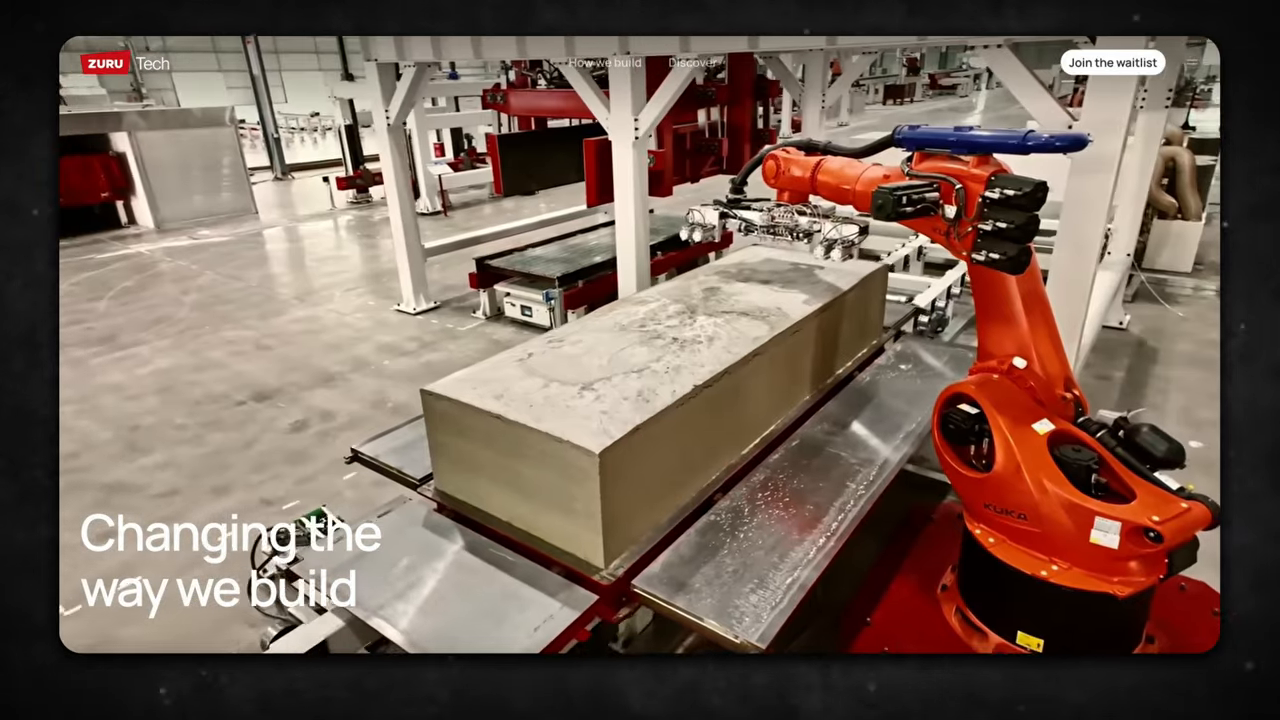
The most interesting AI business opportunities may involve improving physical products and processes, not launching another content generator. In My First Million episode 880, co-hosts Shaan Puri and Sam Parr explore that thesis through companies including ZURU Tech, Isomorphic Labs, and Ohalo, with Puri arguing that the next major opening is AI applied to the physical world.
This interview-style breakdown presents their ideas as attributed answers, with Roger Mendoza’s operator commentary separated below. The central argument is a strategic bet, not a demonstrated formula for getting rich: choose a consequential problem where new technology changes what can be built.
Table of Contents
- TL;DR
- Where are the AI business opportunities beyond software?
- Which physical-world AI applications have concrete problems to solve?
- How should a builder evaluate these ideas without buying the hype?
- Roger’s Take: what is actually replicable?
TL;DR
- Puri’s thesis: AI-generated content and easily replicated software face intense competition; physical-world applications deserve more attention.
- The opportunity map: construction, industrial maintenance, agriculture, drug discovery, defense, materials, ocean technology, and human-body hardware.
- The practical career move: compare attractive companies as an investor would before defaulting to another job or startup in a familiar industry.
- The important caveat: ambitious engineering projects, personal health anecdotes, and projected cost reductions are not interchangeable with verified commercial results.
Where are the AI business opportunities beyond software?
What does Puri mean by AI applied to the physical world?
Puri means using AI to change tangible outcomes: how homes are manufactured, crops are grown, medicines are developed, and machines perform maintenance. The output is not simply more digital material. It is a better product, a different production process, or a physical task completed more effectively.
His concern is that AI makes creating digital products easier for competitors as well as founders. He sees content generation and software tools as vulnerable to downward competitive pressure.
That is his assessment, not proof that software businesses cannot succeed. The useful distinction is between making something easier to produce and building an advantage that remains valuable when production becomes easier.
Runway, Midjourney, ChatGPT, OpenAI, and Anthropic serve as his examples of the previous opportunity window. His question is where someone should position themselves for the next five years, rather than compete only in categories that already attract attention.
Why start with market selection instead of a startup idea?
Puri argues that founders and employees often restrict their choices before investigating the opportunity. They begin with their previous industry, existing contacts, current location, or familiar skills, then select the best option inside that small frame.
His alternative is to evaluate sectors before deciding on a role. He draws on Mark Pincus’s argument that selecting a promising market can matter more than being exceptionally capable in an unpromising one.
The exercise Puri gave a cousin who had sold his company was specific:
- Imagine having $10 million to invest.
- Select five companies that look especially interesting.
- Assume the investor keeps the profits.
- Investigate why those companies appear attractive.
The money is hypothetical. The purpose is to uncover where someone believes meaningful growth could happen, without immediately filtering every possibility through their résumé.
Which physical-world AI applications have concrete problems to solve?
Why are maintenance robots worth investigating?
Puri’s industrial automation examples center on work that already requires substantial human effort: warehouse forklifts, skyscraper window cleaning, removing barnacles from ships, and maintaining bridges.
These examples make the thesis easier to evaluate. Each begins with a recognizable task rather than a broad promise that an autonomous machine will somehow become useful.
- Warehouses: moving goods with automated forklifts.
- Buildings: cleaning windows at height.
- Ships: removing marine growth from hulls.
- Infrastructure: performing maintenance that Puri says is not adequately happening today.
Puri groups these possibilities under autonomy extending beyond cars. His account of Tesla handling roughly 95% of his own driving is a personal report, not evidence that every machine can operate independently or safely in every environment.
The broader opportunity is task-specific automation. The commercial and technical performance of each application still needs investigation.
What makes ZURU Tech an interesting construction example?
ZURU Tech illustrates Puri’s interest in applying manufacturing discipline to housing. He describes factory-produced home components that can be assembled on location, rather than conventional construction carried out almost entirely at the building site.
Parr clarifies an important detail: describing the process simply as 3D printing is misleading. Their discussion emphasizes automated manufacturing, efficient concrete production, precision, and modular assembly.
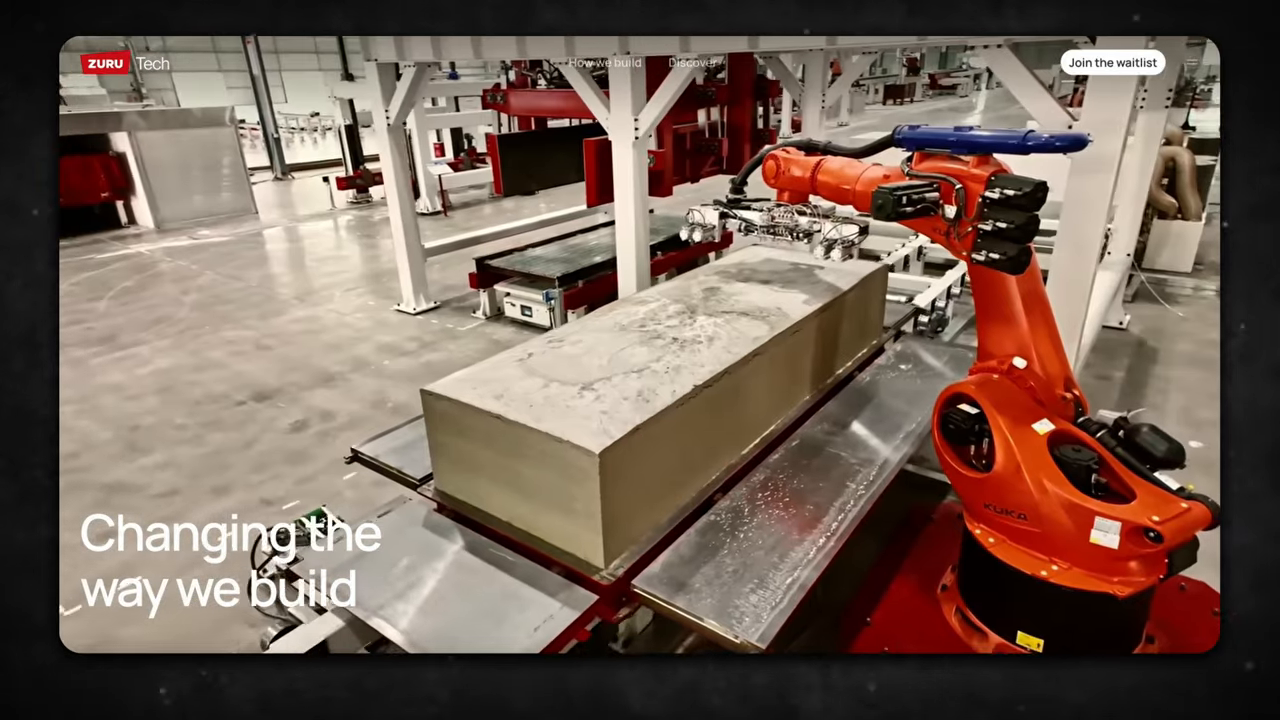
Puri reports that Nick Mowbray and his brother brought approximately 20 years of automated manufacturing experience from the toy industry to the project. He also claims they committed $1 billion of personal capital without external funding.
Other details in Puri’s account include:
- A factory in China reportedly producing approximately one home per day.
- A seismic simulator used to test a roughly 5,000-square-foot home against major earthquake conditions.
- Repeated prototype iteration, with approximately 100 homes outside the factory reportedly housing workers.
- An estimated $60 million to $80 million spent acquiring Los Angeles lots, with plans involving luxury homes valued at $20 million to $40 million.
Those figures are Puri’s reported account, not an audited operating statement. His comparison between local construction costing roughly $600 to $800 per square foot and homes potentially produced 20 times more cheaply is likewise not a verified, like-for-like total-cost comparison.
The useful lesson is the manufacturing approach. The claimed economics require separate diligence.
How does agriculture fit the AI opportunity map?
Puri treats food as an engineered product with room for improvements in seeds, crop characteristics, and field operations. He identifies two connected areas: changing the plants themselves and changing the machinery used to grow them.
Nitroduck, identified as a Y Combinator company, is discussed in connection with CRISPR-based crop modification. The proposed benefits include improved yield, flavor, nutritional characteristics, and growing performance. Those are objectives described in the conversation, not quantified results.
Puri also points to David Friedberg and Ohalo when discussing improved crops, including potatoes and corn. Alongside biological improvements, he mentions tractors and computer vision that could help manage field work.
The practical distinction is important: seed development and agricultural machinery are different businesses. Sharing an industry does not mean sharing the same technical requirements or route to a useful product.
Why does Puri see an opening in AI drug discovery?
Puri believes AI could change the economics and possibilities of developing medicines. He cites Isomorphic Labs and Eli Lilly as examples of organizations pursuing AI-enabled pharmaceutical work.
He characterizes traditional drug development as taking roughly 10 years, costing approximately $2 billion, and experiencing an 80% to 90% failure rate. These are his broad estimates, not a universal benchmark established by the discussion.
The hosts also describe people with cancer who reportedly benefited from technology-assisted research or treatment access. Their former producer Ben is discussed as experiencing a substantial improvement while still having cancer.
These personal accounts do not establish that AI cures cancer. They also do not provide a reproducible treatment protocol. The business thesis concerns research and development; medical conclusions require evidence beyond anecdotes.
Puri’s career advice here is broader than starting a pharmaceutical company. Joining an existing team can also place someone near work they consider consequential.
What other sectors belong on the research list?
Puri identifies several additional categories, but the detail varies considerably. They belong on an exploration list, not on a list of validated startup opportunities.
- Human-body hardware: Neuralink and advanced prosthetics illustrate technology interacting directly with people. Puri mentions a friend named Tyler working on Atom Limbs and emphasizes engineering costs downward so more people can access better prosthetics.
- Ocean technology: a previous conversation with Will O’Brien informs Puri’s interest in ocean-related businesses. He compares the potential attention around oceans with the enthusiasm surrounding space technology, without supplying a detailed business model.
- New materials: Puri expresses interest in materials science but explicitly acknowledges limited understanding. The conversation does not substantiate the more extraordinary claims he has encountered.
- Defense: Anduril is the named example. Puri discusses autonomous systems and the changing economics of equipment, while acknowledging that he is not an authority on battlefield developments.
The defense discussion also includes speculative accounts of an unusual weapon. Those accounts do not provide a sound basis for assessing either technical capability or a business opportunity.
How should a builder evaluate these ideas without buying the hype?
What evidence is missing from an attractive sector thesis?
A promising category is not a customer acquisition plan, a validated product, or a profitable business. Puri explicitly describes his exploration as preliminary rather than deeply researched.
The discussion does not supply launch budgets, pricing, customer acquisition channels, or verified revenue for startups a reader could reproduce. It also does not provide a cheap technical stack for building a drug company, a housing factory, or advanced prosthetics.
That absence matters. A named company demonstrates where to investigate; it does not establish that another founder can reproduce the company’s position.
The clearest evidence boundary is:
- Named examples: organizations and applications to study.
- Reported activity: descriptions of what those organizations are doing.
- Projected benefits: what Puri believes could improve.
- Commercial proof: something the discussion generally does not establish.
What could prevent a new industrial wave from happening?
Parr sees parallels between AI development and earlier periods of industrial expansion. His optimism rests on a combination of resources, entrepreneurial activity, infrastructure, and people.
Puri adds counterarguments: rebuilding manufacturing capability is difficult, enthusiasm does not guarantee execution, and AI could either disrupt employment significantly or disappoint expectations after heavy spending.
Their political discussion ultimately returns to a practical tension: technological progress can be desirable while expensive housing and economic insecurity remain real problems.
For builders, the useful point is not a prediction about national leadership. It is that technical possibility and the ability to deploy something at scale are different questions.
Roger’s Take: what is actually replicable?
What would Roger borrow from Puri’s approach?
I would borrow the market-selection exercise before borrowing any individual idea. Listing five companies forces a useful confrontation: does the next project reflect genuine conviction, or merely familiarity with the last project?
I would also separate the outcome from the enabling technology. Removing barnacles is an outcome. AI is a possible ingredient. The ship does not care how fashionable the ingredient is.
ZURU Tech is particularly useful as a reminder that experience compounds. Puri describes decades of manufacturing knowledge and substantial personal capital behind the project. That is not a weekend-build template. The replicable element is studying how existing expertise transfers into a different industry.
Where would Roger be skeptical?
I would resist replacing one blanket claim with another. “Software is crowded” does not establish that physical-world businesses are better for every founder. Puri offers a direction for research, not comparative return data.
I would also keep extraordinary numbers in a separate diligence column. A claimed 20-fold production improvement is interesting. It is not a housing budget until the comparison is defined.
Finally, I would not confuse proximity with competence. Moving toward an exciting sector can expand someone’s options, as Puri and Parr describe from moving to San Francisco. It does not remove the need to understand the work.
What can a solo builder test this week?
I would turn Puri’s exercise into a small research sprint, not an expensive prototype:
- Choose five companies from sectors that would otherwise sit outside the familiar shortlist.
- Name the physical outcome each company aims to improve.
- Separate reported results from ambitions. Leave unknowns blank rather than filling them with optimism.
- Identify the missing expertise required to understand one company properly.
- Choose one route closer: further research, a conversation with a practitioner, or investigating an existing team.
I would treat the sprint as a test of interest and understanding, not validation of demand. The next step is learning enough to ask a narrower, better question.
The takeaway: AI business opportunities deserve a wider search than content generators and software tools. Start by choosing the problem and market deliberately, then investigate whether the claimed technological advantage survives contact with the actual work.
Today’s next action: write down the five companies that would receive the hypothetical $10 million, with one sentence explaining the attraction of each.
Source: What I’d build if I wanted to get rich with AI by My First Million, episode 880, with Shaan Puri and Sam Parr.
Meta description: Explore AI business opportunities beyond software, from construction to robotics, with Shaan Puri’s market-selection framework and Roger’s take.
FAQ
Which AI business opportunities does Shaan Puri favor?
Puri favors investigating AI applied to physical-world problems, including construction, agriculture, drug discovery, industrial autonomy, materials, ocean technology, defense, and human-body hardware. These are strategic interests, not verified promises of returns.
Does Puri think AI software businesses are finished?
No. Puri argues that content generation and software tools face substantial competitive pressure, but he does not demonstrate that all software businesses lack opportunity.
Is ZURU Tech simply 3D-printing homes?
The discussion describes automated factory manufacturing and modular components assembled on location. Parr specifically distinguishes that process from the simplified description of 3D-printing a home.
Does someone need to start a company to pursue physical-world AI?
No. Puri explicitly suggests joining an existing company as another way to participate, particularly in ambitious scientific and engineering work.
What is Puri’s five-company career exercise?
Imagine investing $10 million across five attractive companies while keeping the profits. The exercise is intended to broaden someone’s opportunity search beyond familiar industries, contacts, and roles.