
Interview with Florin Pop, developer who built $500K by stacking small projects

Table of Contents
- 🎯 Why a portfolio beats the one-hit wonder
- 🧾 The income streams breakdown
- ⚙️ AI-powered launch system for creators (the playbook)
- 🔧 How he manages many projects without melting down
- 🧰 Tech stack and tools Florin actually uses
- 📈 How the pieces compound
- 🧾 Reality check and final advice — what actually works
- 🧩 Extra toolkit — quick hacks and an AI prompt
- ❗ The trends to ignore and what to double down on
- ✅ Closing — where to start tonight
- 📚 Resources and parting notes
- ❓Frequently asked questions
🎯 Why a portfolio beats the one-hit wonder
Solo builders burn out chasing the mythical perfect idea. Florin Pop instead treated his work like an investment portfolio. Over six years he assembled multiple small projects — a course, a SaaS, YouTube content, an ebook, consulting, freelancing, and several tiny products — that together exceeded $500,000 in revenue.
This piece unpacks how he did it: a repeatable loop you can use tonight to test ideas fast, the practical tech stack he relies on, and the exact five-step playbook he uses to find a first win. If the headline interests you, this is the kind of tactical guide that turns scattered energy into a steady, compounding system — think of it as an AI-powered launch system for creators that rewards repetition over perfection.
Pat: Who is Florin and what did he build?
Florin is a developer, content creator, and entrepreneur. He learned to code in high school, freelanced through college, and after a short stint in a full-time role he quit in 2019 to build online. Instead of betting everything on one “big” idea, he iterated on many small ones and treated each project as a low-pressure experiment. Over time those experiments compounded into a portfolio that brought in half a million dollars.
🧾 The income streams breakdown
Florin made a conscious effort to diversify income across product types and distribution channels. The numbers give the strategy context, not the prescription. His biggest single items included a coding course (roughly $180,000 total) and a YouTube path that generated more than $100,000 via ads and sponsorships. He also built a SaaS that did about $68,000 in revenue and was sold later for $50,000. Add freelancing, an ebook worth over $30,000, consulting that brought in another $14,000, and a handful of smaller products that combined to $10,000–$15,000.
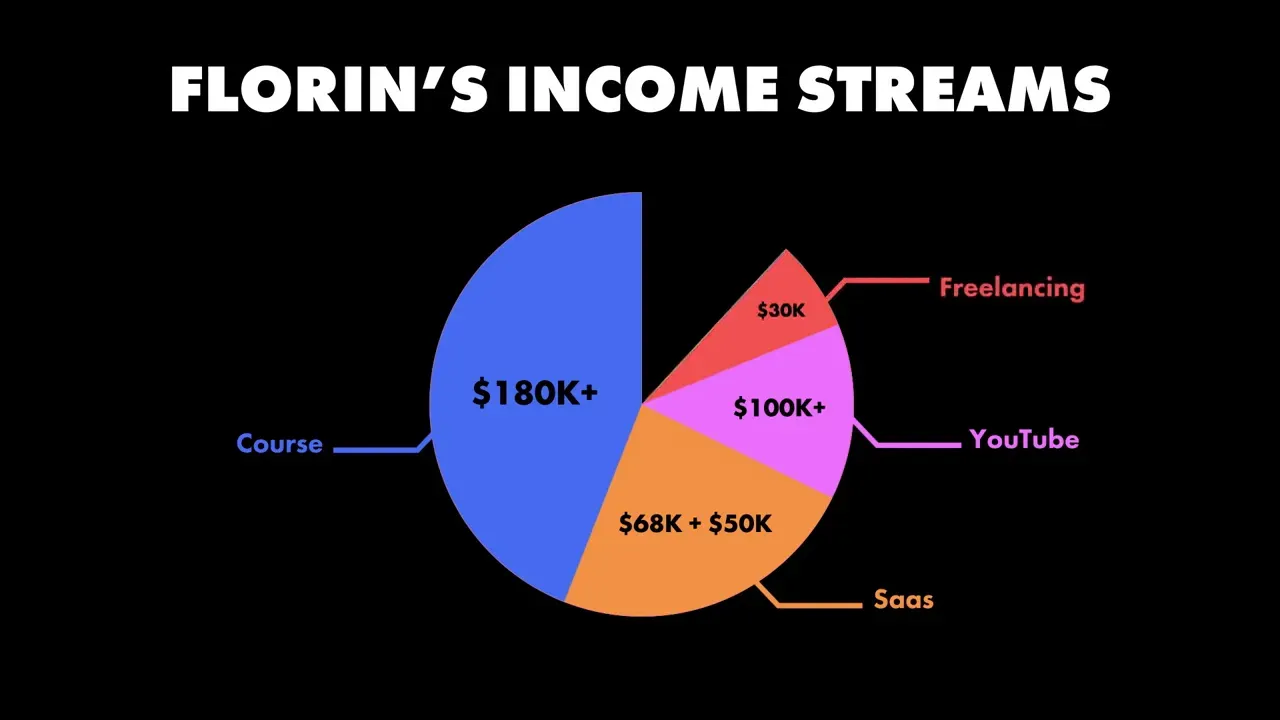
None of those streams was a rocket ship on its own. The point is resilience: if one stream slows down, the rest keep the lights on. That reduced pressure lets him iterate quickly without the emotional or financial risk of “all-in” bets.
Pat: Why build many small things instead of one big thing?
Florin stopped chasing the “one perfect idea” after multiple attempts burned him out. He learned two lessons. First, most projects fail due to timing, distribution, or market mismatch — not because the developer is incompetent. Second, putting everything behind one idea increases emotional and financial risk.
The portfolio approach reduces risk and lets successes compound. Content creates attention, attention makes selling easier, and products create leverage. Over time the combination produces predictable wins instead of gambling on luck.
⚙️ AI-powered launch system for creators (the playbook)
Florin’s five-step loop is minimalist and brutal in its utility. This is a blueprint for an AI-powered launch system for creators who want to test fast and validate with real money.
Pat: What's your exact playbook for finding a first win?
Paraphrasing Florin into a usable checklist:
- Build small and fast. Aim for a useful MVP you can ship in days or weeks. Small tools, micro-apps, or guides work well. Don’t build a feature list for a year. Solve a real pain for yourself first.
- Ship publicly. Post it on the platforms where the customers are: X (Twitter), YouTube, Reddit, TikTok, niche forums. Visibility matters more than polish early on.
- Get feedback relentlessly. Track usage, collect questions, notice complaints, and record who returns. Feedback is the raw data you use to improve or pivot.
- Add monetization early. A paid tier is the fastest validation. If people pay, the problem is worth solving.
- Decide fast — double down or move on. After a defined window (weeks to a few months), make a clear choice. If traction exists, invest. If it’s flat, abandon without guilt and move to the next experiment.
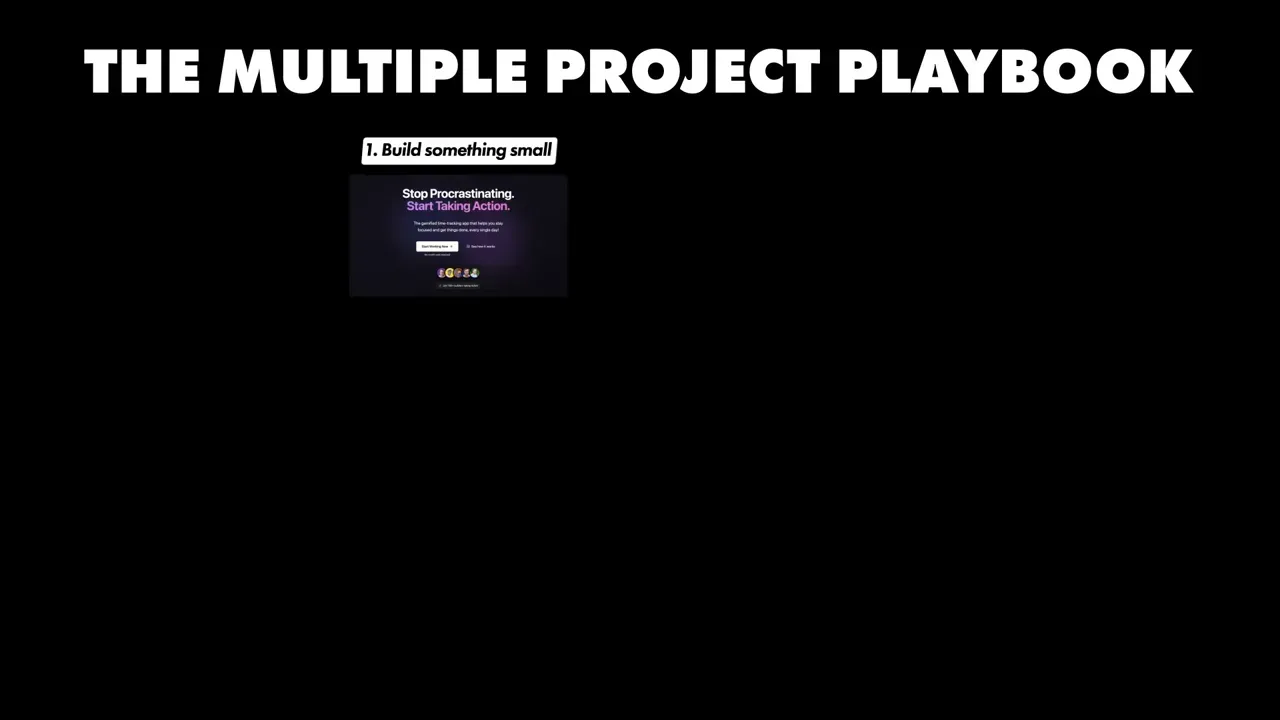
Then apply this loop again and again until something scales. When a product proves viable, simplify it and remove yourself from day-to-day operations. Automation and simplification free time for new experiments and make the product easier to sell later.
🔧 How he manages many projects without melting down
The common misconception is that serial builders run eight things simultaneously. Florin’s reality is sequential. He builds one project, grows it to a sustainable stage, strips out dependency on himself, then starts the next. That pattern avoids scatterbrain syndrome and scales mental bandwidth.
Pat: How do you avoid spreading yourself too thin?
The answer: single-focus per build, then systemize. He doesn’t run eight dev cycles at once. He finishes, automates, and moves on. Many small wins compounding beats one pressured launch that must succeed.
🧰 Tech stack and tools Florin actually uses
This is the solo builder tech stack — lean, modern, and automatable. It’s optimized for speed.
- Next.js for front end and app framework.
- Supabase for database and authentication.
- clean.team for payment processing (as mentioned by Florin).
- Versal for hosting (transcript spelling).
- VHive for newsletter sending.
- DataFest for analytics.
- ChatGPT as the primary AI assistant for ideation, copy, and developer speedups.
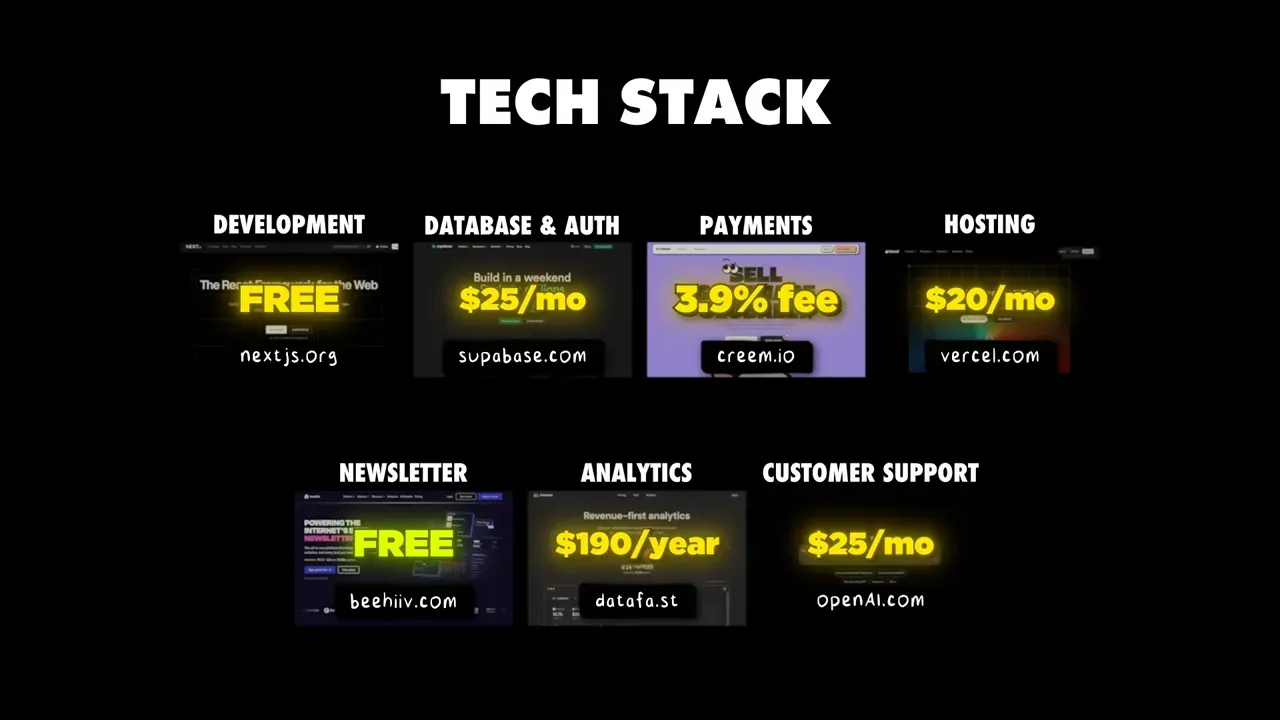
The message here is not holy tooling. It’s pick a few reliable services, automate the repetitive parts, and build faster. The exact combo will differ for each person, but the pattern is consistent: a modern front-end framework, a serverless database with auth, a simple payments integration, a hosting provider, analytics, and an AI assistant.
📈 How the pieces compound
Treat similar things as a cluster that serves the same customer. Florin focused on developers. He created content for developers, products for developers, and a platform for developers to learn. That overlap lets each project feed the others: someone who watched his videos would buy the course; course users could upgrade to a SaaS; newsletter readers become early adopters.
Cross-sell and reuse the same audience rather than building in random niches. This is the “portfolio within a niche” approach that makes multiple products multiply rather than cannibalize.
Pat: Where do people get this multi-project approach wrong?
The main mistake is jumping across unrelated niches. Building a fitness app and a B2B creator tool splits attention and prevents compounding. The right move is to stay adjacent: multiple products, one customer type.
🧾 Reality check and final advice — what actually works
Florin’s closing advice is simple and practical: stop comparing your Level 3 to someone else’s Level 20. The multi-project route reduces pressure, but it still requires consistent shipping and learning. Action produces information. Ship more, learn faster, iterate.
Pat: If you could give your younger self one piece of advice, what would it be?
Don’t compare. Everyone is at a different stage. Focus on shipping, learning, and compounding small wins.
🧩 Extra toolkit — quick hacks and an AI prompt
For builders who want something to run tonight, here are quick, no-nonsense moves:
- Make a one-page tool: pick a problem you face, wire up a form and a tiny API, and deploy. Ship in a day.
- Post the launch thread or a short demo video: one platform is fine. Use a short explainer and a clear call to action to sign up or pay.
- Monetize early: add a $5–$10 paid tier or an early access charge. Money is binary validation.
- Automate the boring parts: use built-in hosting redirects, scheduled emails for onboarding, and simple analytics events to measure retention.
A pragmatic AI prompt Florin leans on for copy and micro-product ideas:
You are an expert product designer for developers. Given this one-line problem: "[BRIEF PROBLEM]", propose
3 micro-product ideas that solve it. For each idea, list the core feature, the MVP scope
(what to build in 1–3 days), and one sentence on how to monetize it.
Replace [BRIEF PROBLEM] with a specific pain you face, for example "I waste time configuring new React projects." The prompt gives immediate, actionable concepts you can test in weekend sprints.
❗ The trends to ignore and what to double down on
Ignore the shiny, bloated platforms promising a single-click exit. They sell a fantasy. What works is repeated, small experiments that validate with real users and real payments. AI is an accelerator not a magic replacement for shipping. Use AI to speed up research, generate drafts, and prototype, but validate with customers early.
✅ Closing — where to start tonight
Florin’s system rewards repetition. The low-friction path is:
- Pick a tiny problem you know from experience.
- Design a minimal solution you can build in days.
- Ship it publicly and ask three people for money or feedback.
- If someone pays, double down. If not, iterate or move on.
This is an AI-powered launch system for creators in its simplest form: combine fast builds, public distribution, early monetization, and AI assistance to compress feedback loops and compound wins.
📚 Resources and parting notes
- Focus on one customer and build multiple solutions around them.
- Automate or remove yourself from projects once they prove viable.
- Stop comparing; start shipping.
❓Frequently asked questions
How much time should I spend before deciding to double down or move on?
Florin’s rule of thumb is a few weeks to a few months. Pick a reasonable window based on the product type. For a tiny tool, a few weeks of measurable usage and some initial revenue is enough. For higher-touch products, allow more time but keep the decision clear.
Do I need to know how to code to follow this approach?
No. The approach is tool-agnostic. Coding helps speed builds and control, but many builders use no-code tools and AI-assisted templates to launch fast. The principle remains: build small, ship, validate with money, then iterate.
What's the best niche to target?
The best niche is one you understand deeply. Florin targeted developers because that was his world. Pick a niche where you can clearly see problems, distribution channels, and early customers.
How does AI fit into the system?
AI speeds ideation, copy, and repetitive tasks. Use it to draft landing pages, create onboarding flows, and generate feature specs. But don’t let AI replace customer validation — money and retention do.
What if I want to sell one of my projects?
Make the product as autonomous as possible before selling. Automate support, keep documentation, and simplify operations. Buyers pay a premium for businesses that don't require the original founder to keep them running.
This article was inspired by this amazing video I Made $500K From 8 Different Income Streams. Check out more from their awesome channel.